<?xml version="1.0" encoding="utf-8"?><feed xmlns="http://www.w3.org/2005/Atom" ><generator uri="https://jekyllrb.com/" version="4.2.0">Jekyll</generator><link href="/feed.xml" rel="self" type="application/atom+xml" /><link href="/" rel="alternate" type="text/html" /><updated>2025-06-30T20:41:59+00:00</updated><id>/feed.xml</id><title type="html">Matthew J. Lacey</title><entry><title type="html">Hindsight is 20/20</title><link href="/2024/11/22/hindsight-is-20-20.html" rel="alternate" type="text/html" title="Hindsight is 20/20" /><published>2024-11-22T00:00:00+00:00</published><updated>2024-11-22T00:00:00+00:00</updated><id>/2024/11/22/hindsight-is-20-20</id><content type="html" xml:base="/2024/11/22/hindsight-is-20-20.html"><![CDATA[<p>Some (as always, <em>strictly personal</em>) thoughts regarding Northvolt’s recently announced Chapter 11 filing. Amongst all the confident hot takes out there speculating what went wrong I think it’s worth taking a brief step back.</p>

<p>While at UU I, and others in the group, had the opportunity to visit Northvolt in 2017 when they were still around 60 employees. A key part of their thesis was that their plan to make ‘good enough’ (my words) NMC batteries would suffice because it was understood there would be plenty of demand - a refreshing perspective at a time when the field was obsessed with next-generation chemistries. They brought with them a lot of experience from Tesla and Asian battery manufacturers and a strong rationale for building the factory in Skellefteå. I bought it - and I don’t remember anyone disagreeing that it was exactly the sort of initiative the EU needed to move away from complete dependence on Asian suppliers, as evidenced by the amount of investment they attracted.</p>

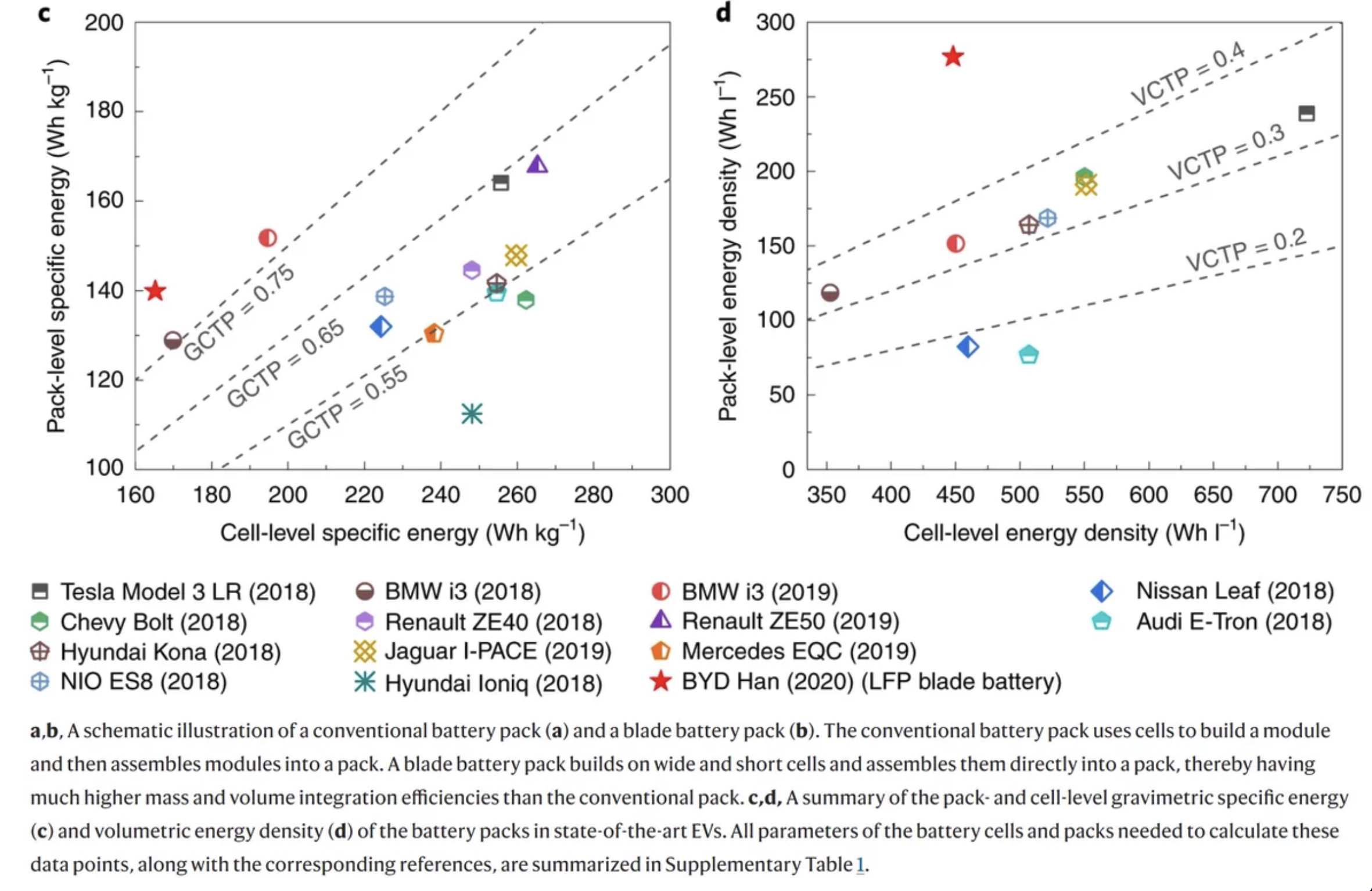
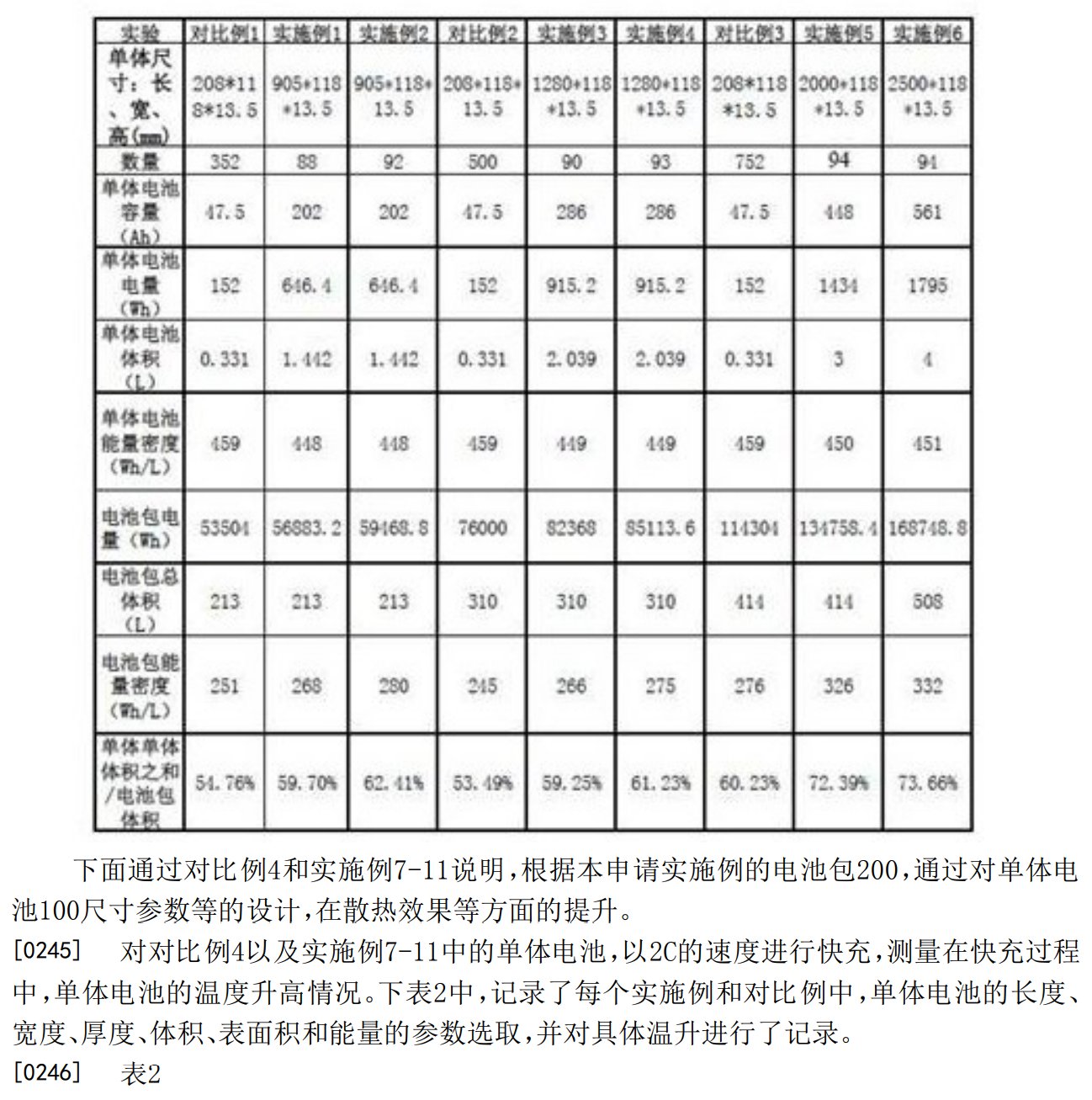
<p>If you look at projections of battery demand and production from that time, you’d see projections of global battery demand around 200 GWh by now. 7 years later, the reality is closer to 1 TWh, with global production being almost 3 times that, dominated by China. To add to that, practically nobody outside of China foresaw the emergence of cell-to-pack and re-emergence of LFP in 2020 which has thrown the future and wisdom of NMC chemistry into doubt in recent years. Everybody knew about the competition from China, and still Chinese companies took everyone by surprise. Batteries are hard, but not impossibly complicated, the likes of CATL, BYD etc are proving that. What is perhaps harder is replicating a relatively mature industry when the incumbents are still well on the front foot.</p>]]></content><author><name></name></author><category term="batteries" /><category term="science" /><category term="northvolt" /><summary type="html"><![CDATA[Some (as always, strictly personal) thoughts regarding Northvolt’s recently announced Chapter 11 filing. Amongst all the confident hot takes out there speculating what went wrong I think it’s worth taking a brief step back. While at UU I, and others in the group, had the opportunity to visit Northvolt in 2017 when they were still around 60 employees. A key part of their thesis was that their plan to make ‘good enough’ (my words) NMC batteries would suffice because it was understood there would be plenty of demand - a refreshing perspective at a time when the field was obsessed with next-generation chemistries. They brought with them a lot of experience from Tesla and Asian battery manufacturers and a strong rationale for building the factory in Skellefteå. I bought it - and I don’t remember anyone disagreeing that it was exactly the sort of initiative the EU needed to move away from complete dependence on Asian suppliers, as evidenced by the amount of investment they attracted. If you look at projections of battery demand and production from that time, you’d see projections of global battery demand around 200 GWh by now. 7 years later, the reality is closer to 1 TWh, with global production being almost 3 times that, dominated by China. To add to that, practically nobody outside of China foresaw the emergence of cell-to-pack and re-emergence of LFP in 2020 which has thrown the future and wisdom of NMC chemistry into doubt in recent years. Everybody knew about the competition from China, and still Chinese companies took everyone by surprise. Batteries are hard, but not impossibly complicated, the likes of CATL, BYD etc are proving that. What is perhaps harder is replicating a relatively mature industry when the incumbents are still well on the front foot.]]></summary></entry><entry><title type="html">Northvolt’s attitude to safety concerns me</title><link href="/2024/08/18/northvolts-attitude-to-safety-concerns-me.html" rel="alternate" type="text/html" title="Northvolt’s attitude to safety concerns me" /><published>2024-08-18T00:00:00+00:00</published><updated>2024-08-18T00:00:00+00:00</updated><id>/2024/08/18/northvolts-attitude-to-safety-concerns-me</id><content type="html" xml:base="/2024/08/18/northvolts-attitude-to-safety-concerns-me.html"><![CDATA[<p>Swedish media are reporting (<a href="https://sverigesradio.se/artikel/northvolts-interna-uppmaning-efter-gaslacka-fortsatt-jobba">here</a> and <a href="https://www.svt.se/nyheter/lokalt/vasterbotten/northvolt-efter-gaslacka-fortsatt-jobba">here</a>) that Northvolt encouraged employees at their Skellefteå plant to continue to work in areas affected by a leak of ammonia, well in excess of legal exposure limits, on the basis that they had PPE which could tolerate the higher levels. I haven’t seen much reporting in English on this, but if the reporting is even remotely correct then this is concerning.</p>

<p>Briefly:</p>

<ul>
  <li>
    <p>Ammonia levels up to 155 ppm were measured, and the maximum exposure limit set by the Swedish Work Environment Authority is 50 ppm</p>
  </li>
  <li>
    <p>The company reportedly encouraged workers to continue working in affected environments with personal protective equipment (PPE) and an internally-determined exposure limit of 500 ppm, on the basis that the PPE could handle this level</p>
  </li>
  <li>
    <p>Northvolt argues that safety is its top priority, that it is following the Work Environment Authority’s guidelines and implies that the media is encouraging workers to be concerned</p>
  </li>
</ul>

<p>My strictly personal thoughts:</p>

<ul>
  <li>
    <p>The 50 ppm level reported is the <em>korttidsgränsvärde</em> (short-term limit), which for the special case of ammonia applies to 5 minutes of exposure (normally, it is 15 minutes). For an 8 hour day, the legal limit is, in fact, 20 ppm (<a href="https://www.av.se/globalassets/filer/publikationer/foreskrifter/hygieniska-gransvarden-afs-2018-1.pdf">source</a>).</p>
  </li>
  <li>
    <p>The US EPA sets the <a href="https://www.epa.gov/aegl/ammonia-results-aegl-program">Acute Exposure Guideline level 2 (AEGL-2)</a> limit for ammonia at 160 ppm for a 60 minute exposure, and 110 ppm for a 4 hour exposure. This is the level above which a person would be expected to be at risk of irreversible health effects and/or an impaired ability to escape - if exposed a single time in their entire life. Northvolt indicate the maximum level they measured was 155 ppm.</p>
  </li>
  <li>
    <p>The US NIOSH sets the <a href="https://www.osha.gov/chemicaldata/623">immediate danger to life and health (IDLH)</a> level at 300 ppm. The AEGL-3 for an 8 hour duration (life-threatening level) is 390 ppm. Both are substantially below Northvolt’s ‘internal limit’</p>
  </li>
  <li>
    <p>The reporting suggests that workers were encouraged to work as normal, with PPE, despite the elevated levels. If true, this bothers me. PPE is the last resort after all other possible risk mitigations. Adopting PPE in this situation would be acceptable if the work was to fix the leak and reduce the ammonia levels. Otherwise, established practice would be to stop work until the root cause is solved and levels brought well below the legal limits</p>
  </li>
  <li>
    <p>Even allowing work to continue with PPE under these conditions carries substantial risk. It assumes the PPE is used correctly, fits correctly, is in good condition, that the workers can use it correctly - at levels which mean serious harm if these assumptions are not correct</p>
  </li>
  <li>
    <p>Ammonia is corrosive and damages the nerves in the nose (and the lungs), causing people to become less sensitive to its smell over time</p>
  </li>
</ul>

<p>Northvolt’s responses to these reports don’t reassure me. My impression is that production comes first, not safety, and I’m not sure using PPE as a workaround while there is a corrosive gas leak in the building is even compliant with legal requirements let alone best practice. I recognise that the company receives a lot of media attention, and could argue the attention is disproportionate, but Northvolt is in the news increasingly for all the wrong reasons. A cursory look at Swedish social media shows that their public image is taking a beating right now. I want to see them succeed, but their approach to safety, public relations, and working conditions has to match the lofty ambitions and vision they have for industrial transformation.</p>]]></content><author><name></name></author><category term="batteries" /><category term="science" /><summary type="html"><![CDATA[Swedish media are reporting (here and here) that Northvolt encouraged employees at their Skellefteå plant to continue to work in areas affected by a leak of ammonia, well in excess of legal exposure limits, on the basis that they had PPE which could tolerate the higher levels. I haven’t seen much reporting in English on this, but if the reporting is even remotely correct then this is concerning. Briefly: Ammonia levels up to 155 ppm were measured, and the maximum exposure limit set by the Swedish Work Environment Authority is 50 ppm The company reportedly encouraged workers to continue working in affected environments with personal protective equipment (PPE) and an internally-determined exposure limit of 500 ppm, on the basis that the PPE could handle this level Northvolt argues that safety is its top priority, that it is following the Work Environment Authority’s guidelines and implies that the media is encouraging workers to be concerned My strictly personal thoughts: The 50 ppm level reported is the korttidsgränsvärde (short-term limit), which for the special case of ammonia applies to 5 minutes of exposure (normally, it is 15 minutes). For an 8 hour day, the legal limit is, in fact, 20 ppm (source). The US EPA sets the Acute Exposure Guideline level 2 (AEGL-2) limit for ammonia at 160 ppm for a 60 minute exposure, and 110 ppm for a 4 hour exposure. This is the level above which a person would be expected to be at risk of irreversible health effects and/or an impaired ability to escape - if exposed a single time in their entire life. Northvolt indicate the maximum level they measured was 155 ppm. The US NIOSH sets the immediate danger to life and health (IDLH) level at 300 ppm. The AEGL-3 for an 8 hour duration (life-threatening level) is 390 ppm. Both are substantially below Northvolt’s ‘internal limit’ The reporting suggests that workers were encouraged to work as normal, with PPE, despite the elevated levels. If true, this bothers me. PPE is the last resort after all other possible risk mitigations. Adopting PPE in this situation would be acceptable if the work was to fix the leak and reduce the ammonia levels. Otherwise, established practice would be to stop work until the root cause is solved and levels brought well below the legal limits Even allowing work to continue with PPE under these conditions carries substantial risk. It assumes the PPE is used correctly, fits correctly, is in good condition, that the workers can use it correctly - at levels which mean serious harm if these assumptions are not correct Ammonia is corrosive and damages the nerves in the nose (and the lungs), causing people to become less sensitive to its smell over time Northvolt’s responses to these reports don’t reassure me. My impression is that production comes first, not safety, and I’m not sure using PPE as a workaround while there is a corrosive gas leak in the building is even compliant with legal requirements let alone best practice. I recognise that the company receives a lot of media attention, and could argue the attention is disproportionate, but Northvolt is in the news increasingly for all the wrong reasons. A cursory look at Swedish social media shows that their public image is taking a beating right now. I want to see them succeed, but their approach to safety, public relations, and working conditions has to match the lofty ambitions and vision they have for industrial transformation.]]></summary></entry><entry><title type="html">Battery metrics - the gap between theory and practice</title><link href="/2023/01/31/gap-between-theory-and-practice.html" rel="alternate" type="text/html" title="Battery metrics - the gap between theory and practice" /><published>2023-01-31T00:00:00+00:00</published><updated>2023-01-31T00:00:00+00:00</updated><id>/2023/01/31/gap-between-theory-and-practice</id><content type="html" xml:base="/2023/01/31/gap-between-theory-and-practice.html"><![CDATA[<div class="alert alert-info">
Original post at Twitter <a href="https://twitter.com/mjlacey/status/1620385116332630016?s=20&amp;t=sj6SPE96QJs3YYWGWwCWHg">here</a>
</div>

<p>Have you read the <a href="https://www.nature.com/articles/s41467-023-35933-2">new perspective article</a> by me, <a href="https://twitter.com/JamesTFrith">James Frith</a> and <a href="https://twitter.com/UldericoUlissi">Ulderico Ulissi</a> yet?</p>

<p>Just one of the many topics we discuss is the gap between theory and practice in terms of metrics such as energy density, which I’ll briefly elaborate on here.</p>

<p>Specific energy (Wh/kg) and energy density (Wh/L) are two very important metrics for batteries (though far from the only important ones), as they describe the weight or volume required to store a given energy. Batteries are, if we’re honest, not that good at this.</p>

<!--more-->

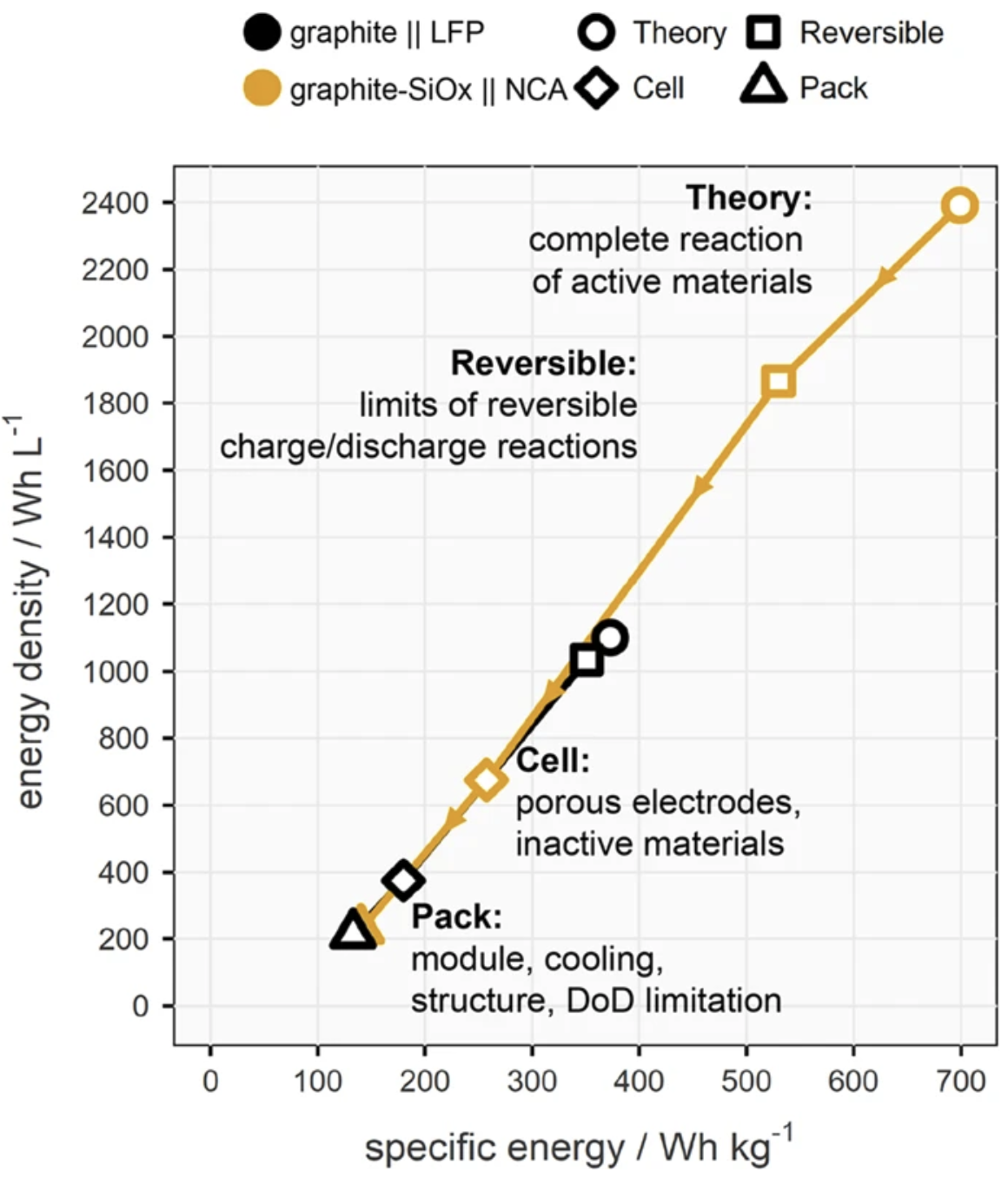
<p>Naturally, when we go looking for new battery materials to increase energy density, we’re looking for combinations with a very high theoretical energy release for their weight or volume. A classic ‘holy grail’ (an overused cliché) is a battery based on lithium and oxygen gas. The reaction 2 Li + O<sub>2</sub> &lt;=&gt; Li<sub>2</sub>O<sub>2</sub> (Li-O<sub>2</sub> battery) theoretically releases ~3500 Wh/kg (based on the mass of the reactants), which is a lot higher than Li-ion batteries at ~270 Wh/kg today, a comparison you could probably find in many papers on this and similar systems.</p>

<p>Except, this is a completely inappropriate comparison, since we are comparing two different numbers - a materials-level metric and a cell-level figure. The cell-level figure is always (significantly) lower than the materials-level figure, due to several factors.</p>

<p>For cell-level, these factors include the additional materials essential to make the cell function (current collectors, separator, electrolyte, packaging) as well as constraints on the practical reversibility of the chemical reaction.I have heard it said before that as a rule of thumb you can take the theoretical Wh/kg figure and divide by 4 to get the practical maximum. But this rule of thumb doesn’t work, and our article illustrates why this is the case.</p>

<p>In our article, we compare the progression from theoretical (materials-level) to practical (pack-level) for two rather different battery types - small, cylindrical graphite/SiO<sub>x</sub> | NCA(e.g. Tesla) and large, prismatic, graphite | LFP (e.g. BYD).</p>

<div class="card mb-3">
    <img class="card-img-top" src="/img/posts/gap-theory-practice.png" />
    <div class="card-body bg-light">
        <div class="card-text">
            Visualisation of energy losses between theory and system level
        </div>
    </div>
</div>

<p>We selected this comparison due to the recent ‘renaissance’ of LFP and the arrival of LFP-based systems with very competitive performance in terms of energy density compared to incumbent NMC/NCA batteries, despite a factor of ~2 difference in theoretical energy density.</p>

<p>There are a number of reasons why the LFP makes up this gap. One is that the reaction can be made reversible closer to the theoretical maximum. But more significant has been the pack-level engineering that takes advantage of LFP’s better thermal stability, which more easily allows for large cells to be sandwiched together in a very volume-efficient way, due to the reduced risk for thermal runaway &amp; propagation.</p>

<p>With this so-called CTP concept we’re now dividing by &lt; 3 for the LFP system from theory to <em>pack</em> level. And since we started writing this article, new products such as CATL’s Qilin pack promise to bring similar benefits to NMC systems and push the envelope further. This also goes to show that there is plenty of mileage in comparatively incremental improvements, especially as we see tighter battery-vehicle integration (e.g. cell-to-car) in the future.</p>

<p>It is also notable that amongst Western automakers, the drive for higher energy density instead led to huge investments in startups developing silicon anodes and solid state batteries, which are not expected to be deployed in production vehicles for several years yet.</p>

<p>For the academic aspect, to briefly return to my Li-O<sub>2</sub> discussion from the start of this thread: I think one of the (many) reasons why the research interest in Li-O<sub>2</sub> batteries fell sharply in the mid-2010s was the realisation that a Li-air battery, where the system would have to tolerate N<sub>2</sub>, CO<sub>2</sub>, H<sub>2</sub>O and everything else found in air, was extremely unlikely and the cathode would have to be a sealed system with an O<sub>2</sub> tank. This would have dragged the energy density down enormously, probably to a level not competitive with technologies at a much higher TRL today.</p>

<p>For future materials discovery, I think it’s important from the start to have a realistic expectation of where practical performance might end up and where the biggest bottlenecks might be found.</p>

<p>Modelling is important here, even a very simple model (e.g. https://github.com/mjlacey/cellmodels/) goes a long way to understanding at least some of the tradeoffs.</p>

<p>What do you think?</p>]]></content><author><name></name></author><category term="batteries" /><category term="twitter" /><category term="science" /><category term="reality check" /><summary type="html"><![CDATA[Original post at Twitter here Have you read the new perspective article by me, James Frith and Ulderico Ulissi yet? Just one of the many topics we discuss is the gap between theory and practice in terms of metrics such as energy density, which I’ll briefly elaborate on here. Specific energy (Wh/kg) and energy density (Wh/L) are two very important metrics for batteries (though far from the only important ones), as they describe the weight or volume required to store a given energy. Batteries are, if we’re honest, not that good at this.]]></summary></entry><entry><title type="html">Reinventing the DCIR wheel</title><link href="/2022/12/05/reinventing-the-dcir-wheel.html" rel="alternate" type="text/html" title="Reinventing the DCIR wheel" /><published>2022-12-05T00:00:00+00:00</published><updated>2022-12-05T00:00:00+00:00</updated><id>/2022/12/05/reinventing-the-dcir-wheel</id><content type="html" xml:base="/2022/12/05/reinventing-the-dcir-wheel.html"><![CDATA[<div class="alert alert-info">
Original post at Twitter <a href="https://twitter.com/mjlacey/status/1599750794181591041?s=20&amp;t=qV-VPjA3IHi_R-iSGb53kA">here</a>
</div>

<p>There is a <a href="https://doi.org/10.1021/acs.chemmater.2c02376">new paper</a> out comparing AC &amp; DC methods for resistance determination in batteries which frustrates me, for several reasons. Some of these reasons are purely self-centred but others I think reflect many problems with publishing today.</p>

<!--more-->

<p>I’ll get (some) selfish reasons out of the way first. The paper compares resistance measurements made by constant current pulses and by AC signals (EIS) for polymer electrolyte-based batteries and finds them to be similar.</p>

<p>I’ve been working on this topic for 8 years, specifically the “intermittent current interruption” approach (a DC method conceptually the same as galvanostatic pulse), w/ several publications explicitly validating the method against EIS, including on a theoretical basis, also including 2 papers studying polymer electrolyte-based batteries. None of my work is cited despite the very strong relevance. I can cope with that, there’s a lot of literature out there.</p>

<p>But reading this paper, one could get the impression that DC resistance measurements are an overlooked technique which no-one thinks to use, when in reality it is the <em>standard</em> technique in the battery industry.</p>

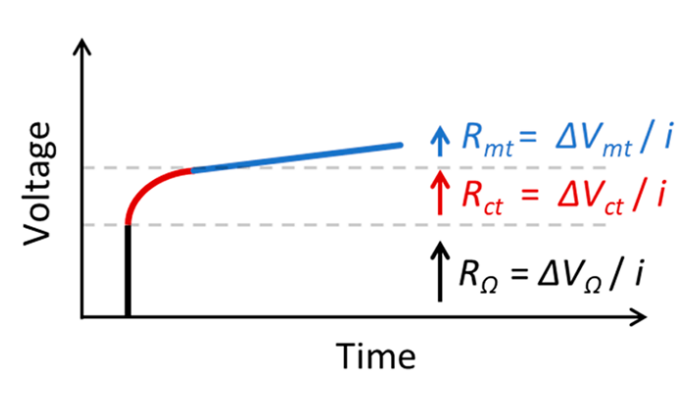
<p>There doesn’t seem to be any cited literature on using DCIR, and I can’t distinguish the method in this paper from conventional DCIR except for dividing the potential response into three regions corresponding to major processes (ohmic, charge transfer, mass transport). I then take issue with the conclusion of the paper that the DC and AC methods “reveal even similar values” for these major processes. Why would we expect otherwise? If you have a system you can model with an equivalent circuit (not done here) why shouldn’t the methods be capable of giving you <em>exactly</em> the same result?</p>

<p>(One of) the historical problem(s) in connecting DCIR and EIS is that DCIR tends to look at the magnitude of voltage changes at arbitrary times, making the resistances somewhat time dependent.</p>

<div class="card mb-3">
    <img class="card-img-top" src="/img/posts/dcir-1.png" />
    <div class="card-body bg-light">
        <div class="card-text">
            Selected figure from the paper, showing division of potential response into ohmic, charge transfer and mass transport resistances
        </div>
    </div>
</div>

<p>You can deal with this by fitting to an equivalent circuit model but this hasn’t been done here. In fact there is a rather questionable simplification where the capacitive contribution is just ignored so long as it doesn’t contribute too much (Fig S1). That might work for this system with a high ohmic contribution, but what about other systems?</p>

<p>These are questions which the research I have done on “ICI” has focused on for several years, through careful simplification of the system and the theoretical basis. In our (my and Yu-Chuan Chiens) approach we simplify to fitting the mass transport-controlled region to get two quantities, “R” (ohmic + ‘charge transfer’) + “k” (mass transport). Unlike the paper under scrutiny here, both have the important characteristic of being, in theory, both independent of current and time. And, under ideal conditions, you get <em>identical</em> values from EIS (see e.g. <a href="https://pubs.acs.org/doi/abs/10.1021/jacs.9b11500">this paper</a>.</p>

<p>This technique works and we have used it in a number of studies on Li-S batteries, Li-ion batteries (including commercial cells), Na-ion batteries, in combination with in situ/operando studies (v. useful). I think this is a good demonstration of the value of DC-based methods.</p>

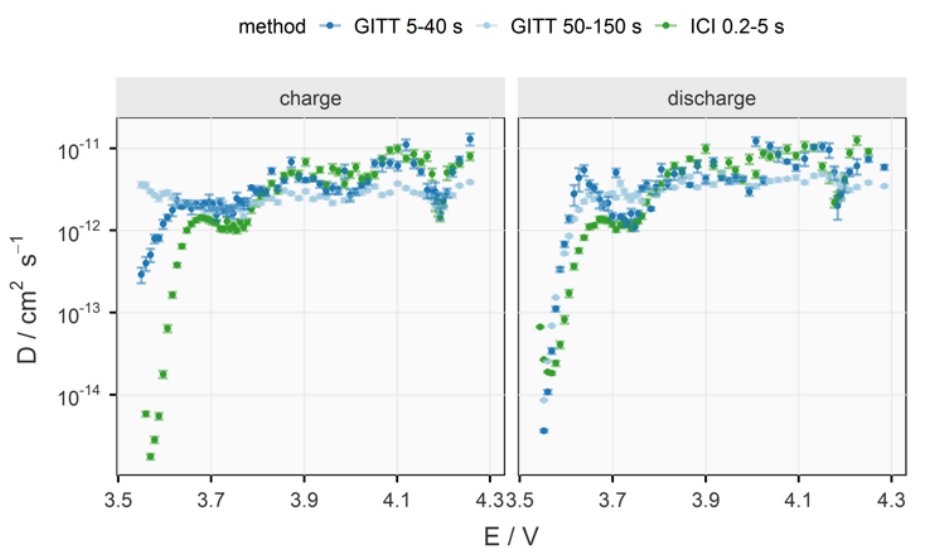
<p>But there’s more - in two recent studies (<a href="https://doi.org/10.26434/chemrxiv-2021-09srz">one in pre-print</a>), we have shown that we can extend the analytical treatment so that (with care) we can determine diffusion coefficients from ICI measurements in a matter of seconds.</p>

<div class="card mb-3">
    <img class="card-img-top" src="/img/posts/dcir-2.jpeg" />
    <div class="card-body bg-light">
        <div class="card-text">
            Diffusion coefficient vs E for NMC811
        </div>
    </div>
</div>

<p>This for me a good demonstration of what is possible with a short-duration DC pulse.</p>

<p>Which brings me onto my last point: we first submitted the above pre-print to <em>Chem. Mater.</em> because we thought an easy technique that could add an extra dimension to in situ/operando studies without the burden of interpretation and slowness of EIS would be very interesting to materials chemists. But it was rejected after review as being out of journal scope, specifically because we considered the theoretical basis, derived the equations for the technique we proposed, described limitations and shared the code - therefore it should be in a specialised journal only..?</p>

<p>So it is frustrating to see the same journal publish a paper with a very similar aim, but a much less useful method, not least because it is unclear how some of the quantities are even calculated (e.g., “some milliseconds”). It is also frustrating to see this journal, and these authors, which I otherwise have a high opinion of, publish this also considering that 21/35 references are self-citations, which should raise eyebrows for a topic with a very rich selection of existing literature.</p>

<p>So I’m going to round off this long thread with a few general requests to anyone who is still reading:</p>

<p>1) Authors: please make every effort to read cite the primary literature, even if you arrived at some aspects independently - something similar has almost certainly been done before. I really tried hard to look for previous reports of ICI or similar methods before I published.</p>

<p>2) Senior authors/PIs: give credit to junior researchers and/or smaller groups where credit is due. I have seen and experienced senior profs presenting concepts as their own when key work was done by less well known researchers and it’s not cool. Yu-Chuan Chien deserves a very large slice of the credit for developing the analytical basis of ICI and turning it into a genuinely useful technique that is used by a few research groups now and even a couple of companies.</p>

<p>3) Reviewers: just because an interdisciplinary paper has technical stuff from a different area you aren’t familiar with, doesn’t mean it should be in a specialised journal in that field. Just b/c a technique has limitations (all do) doesn’t mean it has no real application.</p>

<p>4) Editors: I know you do a really difficult job and there is no way to make the peer review process fully fair. But I’m sure we can do better than this and I think a bit more dialogue with authors where possible would help. I hope.</p>]]></content><author><name></name></author><category term="batteries" /><category term="twitter" /><category term="science" /><summary type="html"><![CDATA[Original post at Twitter here There is a new paper out comparing AC &amp; DC methods for resistance determination in batteries which frustrates me, for several reasons. Some of these reasons are purely self-centred but others I think reflect many problems with publishing today.]]></summary></entry><entry><title type="html">Commentary on the teardown of the Tesla 4680 cell at The Limiting Factor</title><link href="/2022/07/18/commentary-tesla-4680-teardown.html" rel="alternate" type="text/html" title="Commentary on the teardown of the Tesla 4680 cell at The Limiting Factor" /><published>2022-07-18T00:00:00+00:00</published><updated>2022-07-18T00:00:00+00:00</updated><id>/2022/07/18/commentary-tesla-4680-teardown</id><content type="html" xml:base="/2022/07/18/commentary-tesla-4680-teardown.html"><![CDATA[<div class="alert alert-info">
Original post at Twitter <a href="https://twitter.com/mjlacey/status/1548945244569452546?s=20&amp;t=PrG5tIrgiVt1GxWbMWfFDg">here</a>
</div>

<p>So I had been meaning for a while to do a little commentary on the Tesla 4680 teardown organised by <a href="https://twitter.com/LimitingThe">The Limiting Factor</a>, partly because teardown is part of my day job… so here come some observations, starting with the <a href="https://t.co/zNXzrQCMbV">“part 1” video</a>:</p>

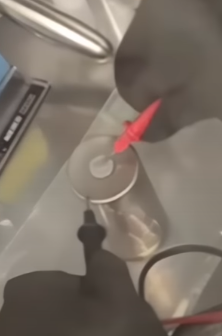
<p><code class="language-plaintext highlighter-rouge">4:27</code> - Cell voltage is pretty low, 0.14 V - which is way below the usual 0% SoC. The cell is dented, but the voltage is not zero, so tells me it’s not short circuited (at least at the time of teardown) - guessing it was discarded from the line and hasn’t gone through formation</p>

<!--more-->

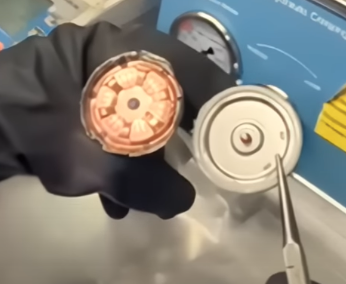
<p>Interesting new features about this format: large areas to connect both electrodes on the top of the cell (centre: +ve, outside: -ve). The bottom (where I guess the can is crimped closed) is insulated from the rest of the can and has (I expect) a safety vent.</p>

<div class="card mb-3">
    <img class="card-img-top" src="/img/posts/4680teardown-1.png" />
    <div class="card-body bg-light">
        <div class="card-text">
            Measuring the OCV at the terminals
        </div>
    </div>
</div>

<div class="card mb-3">
    <img class="card-img-top" src="/img/posts/4680teardown-2.png" />
    <div class="card-body bg-light">
        <div class="card-text">
            Insulated bottom of the cell can
        </div>
    </div>
</div>

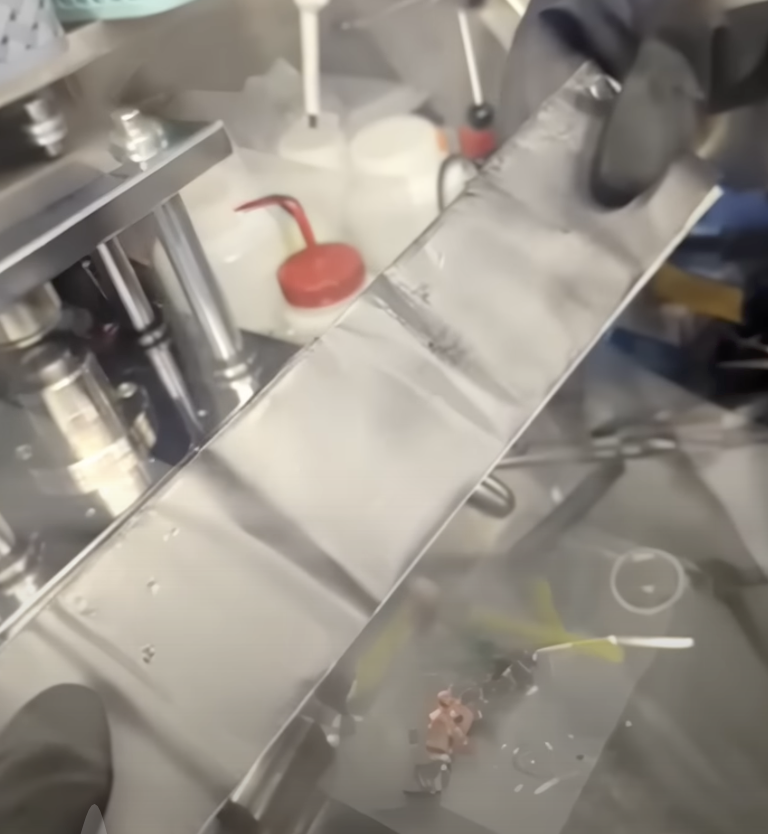
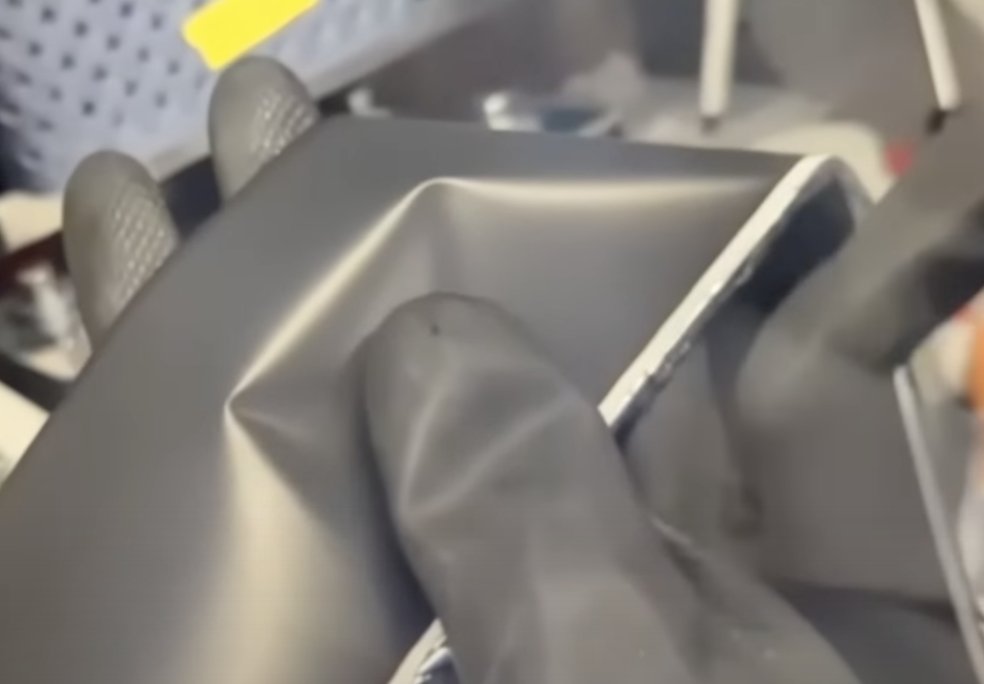
<p><code class="language-plaintext highlighter-rouge">7:31</code> - already this cell looks like hard work to get into! Opening cells with manual tools is hard, and the glove box doesn’t make it easier, with high risk of short-circuit, cutting gloves etc. At least in this case the cell is totally dead.</p>

<div class="card mb-3">
    <img class="card-img-top" src="/img/posts/4680teardown-3.png" />
    <div class="card-body bg-light">
        <div class="card-text">
            Opening the cell can
        </div>
    </div>
</div>

<p>In this situation I would have probably tried to go for a pipe cutter to open the cell (and an x-ray before can help show where things are). We know the jelly roll is wrapped in separator as well, so I think with some care that would have been faster and easier.</p>

<div class="card mb-3">
    <img class="card-img-top" src="/img/posts/4680teardown-4.jpeg" />
    <div class="card-body bg-light">
        <div class="card-text">
            4680 jelly roll assembly
        </div>
    </div>
</div>

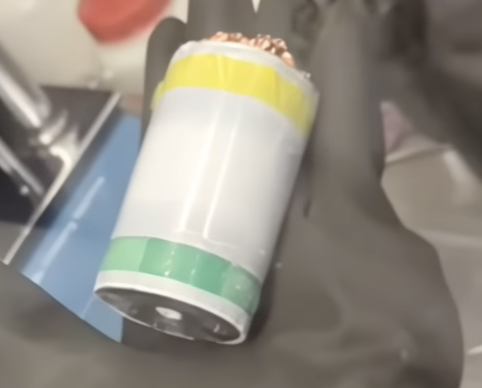
<p><code class="language-plaintext highlighter-rouge">13:48</code> - finally the bottom cap comes off and can see the copper anode. Still a bit curious as to how the cap is insulated. I guess it is done so the cell can be connected to a cooling plate without shorting all the cells, was wondering if the cap coated or something…</p>

<div class="card mb-3">
    <img class="card-img-top" src="/img/posts/4680teardown-5.png" />
    <div class="card-body bg-light">
        <div class="card-text">
            Removing the cell cap
        </div>
    </div>
</div>

<p>I’m not that closely following pack teardown efforts but guessing the cells are bottom (and side?)-cooled, and the thermal conductivity is best going towards the bottom of the cell. Not that knowledgeable on these things though. Not unusual that the rest of the cell can is connected to the -ve electrode though, this is normal with cylindrical (and with aluminum-can prismatics, the can is normally connected to positive).</p>

<p>Arbitrary time for a tip for any lab doing interesting stuff in a glove box: buy a camera to have in the glove box! Makes for much better pictures than taking photos through the glass…</p>

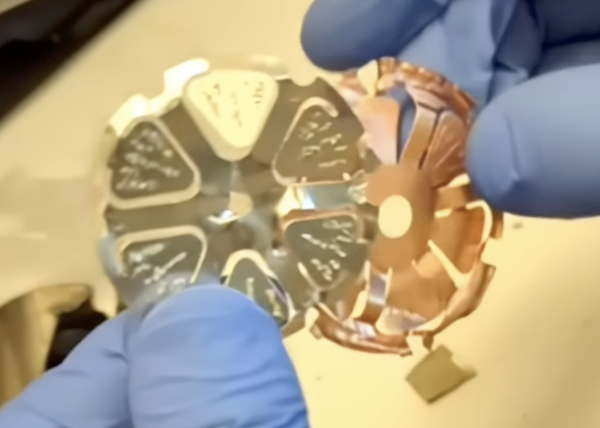
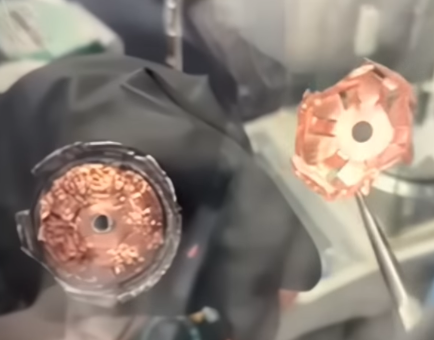
<p><code class="language-plaintext highlighter-rouge">21:48</code> - was curious to learn before how the connection of the tabless electrode would be made because I figured this would be both tricky and important. Seems this ‘flower’ of Cu is welded to the jelly roll (presumably before going into the can)…</p>

<div class="card mb-3">
    <img class="card-img-top" src="/img/posts/4680teardown-6.png" />
    <div class="card-body bg-light">
        <div class="card-text">
            Removing the 'flower'
        </div>
    </div>
</div>

<p>…and then a flower-to-can connection is made later? The weld, I imagine, is crucial - need it to avoid a high contact resistance to the can, and must avoid bringing contaminant particles into the cell which could create a short circuit later.</p>

<p><code class="language-plaintext highlighter-rouge">28:07</code> - finally getting the jelly roll out is pretty satisfying, even to watch! And probably just as well it’s not an aged cell as with a bit of swelling, would have had to cut away more of the can.</p>

<div class="card mb-3">
    <img class="card-img-top" src="/img/posts/4680teardown-7.png" />
    <div class="card-body bg-light">
        <div class="card-text">
            Removing the jelly roll
        </div>
    </div>
</div>

<p><code class="language-plaintext highlighter-rouge">30:46</code> - kinda interesting that the separator comes all the way down to the tab edge of the +ve electrode  but the -ve electrode sticks out of the end. Guessing that is so the -ve can make a bigger contact to the sides at the bottom?</p>

<div class="card mb-3">
    <img class="card-img-top" src="/img/posts/4680teardown-8.png" />
    <div class="card-body bg-light">
        <div class="card-text">
            Jelly roll removed
        </div>
    </div>
</div>

<p><code class="language-plaintext highlighter-rouge">33:01</code> - also interesting that the first couple of turns do not have the ‘tabless’ tabs sticking out of the top. Looks maybe 40-50 cm or so? And would have a first guess the whole roll is ~3.5 m fully unwound so it seems a fairly big portion.</p>

<div class="card mb-3">
    <img class="card-img-top" src="/img/posts/4680teardown-9.png" />
    <div class="card-body bg-light">
        <div class="card-text">
            Positive electrode
        </div>
    </div>
</div>

<p><code class="language-plaintext highlighter-rouge">40:43</code> - Pretty nice looking electrodes - looks homogeneous, ‘shiny’, decent adhesion, no cracking etc. Seems also that there’s a relatively large amount of separator sticking out either side of the electrode too?</p>

<div class="card mb-3">
    <img class="card-img-top" src="/img/posts/4680teardown-10.png" />
    <div class="card-body bg-light">
        <div class="card-text">
            Homogeneous-looking electrodes
        </div>
    </div>
</div>

<p><code class="language-plaintext highlighter-rouge">42:43</code> - Weikang also notes that the electrodes and separator look very clean, hasn’t been cycled and probably not gone through formation, as I guessed earlier. Probably would look the same even if formed and just a few gentle cycles, I would think.</p>

<p><code class="language-plaintext highlighter-rouge">43:23</code> - Might have mistaken it for separator earlier but interesting to note this coating - maybe aluminium oxide? - along the top edge of the positive electrode. I believe there are other manufacturers doing this too, and expect it’s for safety reasons.</p>

<div class="card mb-3">
    <img class="card-img-top" src="/img/posts/4680teardown-11.jpeg" />
    <div class="card-body bg-light">
        <div class="card-text">
            Aluminium oxide coating
        </div>
    </div>
</div>

<p>I guessed ~3.5 m and the positive is estimated at about 3.3 m, and 70 mm wide - assuming the capacity is at least 25 Ah that would put the electrode capacity &gt;5 mAh/cm2, which is pretty thick! Didn’t spot it in the video but was curious about the separator. It’s common now to have an aluminium oxide or boehmite coating generally on the +ve-facing side. Can sort of see this as it tends to appear matte, and the uncoated side shiny, but can’t see in the video.</p>

<p><code class="language-plaintext highlighter-rouge">57:07</code> - Didn’t know up to this point that 4.5 µm Cu foil was in production! That’s crazy thin. There’s also perhaps a relevant trade off here. Thinner Cu means better energy density, but less ability to conduct heat from the electrodes away through the Cu.</p>

<p><code class="language-plaintext highlighter-rouge">1:07:16</code> - what kind of steel is the can made of? I would guess here Ni-plated steel, as it is quite commonly used for cylindrical and coin cells for good strength, corrosion resistance etc. But can’t tell just by looking…</p>

<p><code class="language-plaintext highlighter-rouge">1:08:00</code> - ~600 µm thick steel is v. thick! That’s 4-5x thicker than is typical for a smaller (2170/18650) cylindrical cell. It’s much more in line with the thickness of Al in prismatic cans, but there they are much lighter. So the can has got to be relatively heavy here</p>

<p><code class="language-plaintext highlighter-rouge">1:11:17</code> The different directions of the ‘petals’ in the ‘flowers’ is interesting.</p>

<div class="card mb-3">
    <img class="card-img-top" src="/img/posts/4680teardown-12.png" />
    <div class="card-body bg-light">
        <div class="card-text">
            Current collector "petals"
        </div>
    </div>
</div>

<p>Wonder if there is a reason for this besides accommodating different size central parts for each of them (the centre of the +ve is connected to the ‘button’ on the top of the cell, but the edge contact to the can on the -ve is on the side).</p>

<p><code class="language-plaintext highlighter-rouge">1:11:39</code> - Is the can so thick because it is structural? I’m not sure if this is the case or if it is just to manage swelling, but I do wonder why the can needs to be 4-5x usual thickness if it’s just to manage swelling alone (and sacrifice energy density in the process)</p>

<p>Ok, reached the end! Nice to get a proper look at the inside of the cell but what I’m most interested in is the specs. And since I took so long to make this thread there’s already an <a href="https://t.co/YDstWe28rt">initial video</a> on that too!</p>

<p><code class="language-plaintext highlighter-rouge">1:26</code> - A note that this cell is from about 6 mo ago and is not a production version, so some things may differ. Might be true, but if the cell is that recent then it is probably “C-sample” or similar and I doubt it would differ in any significant way from a production cell. Changes to chemistry, thicknesses, production methods etc are very risky to change at this stage even if Tesla are supplying to themselves.</p>

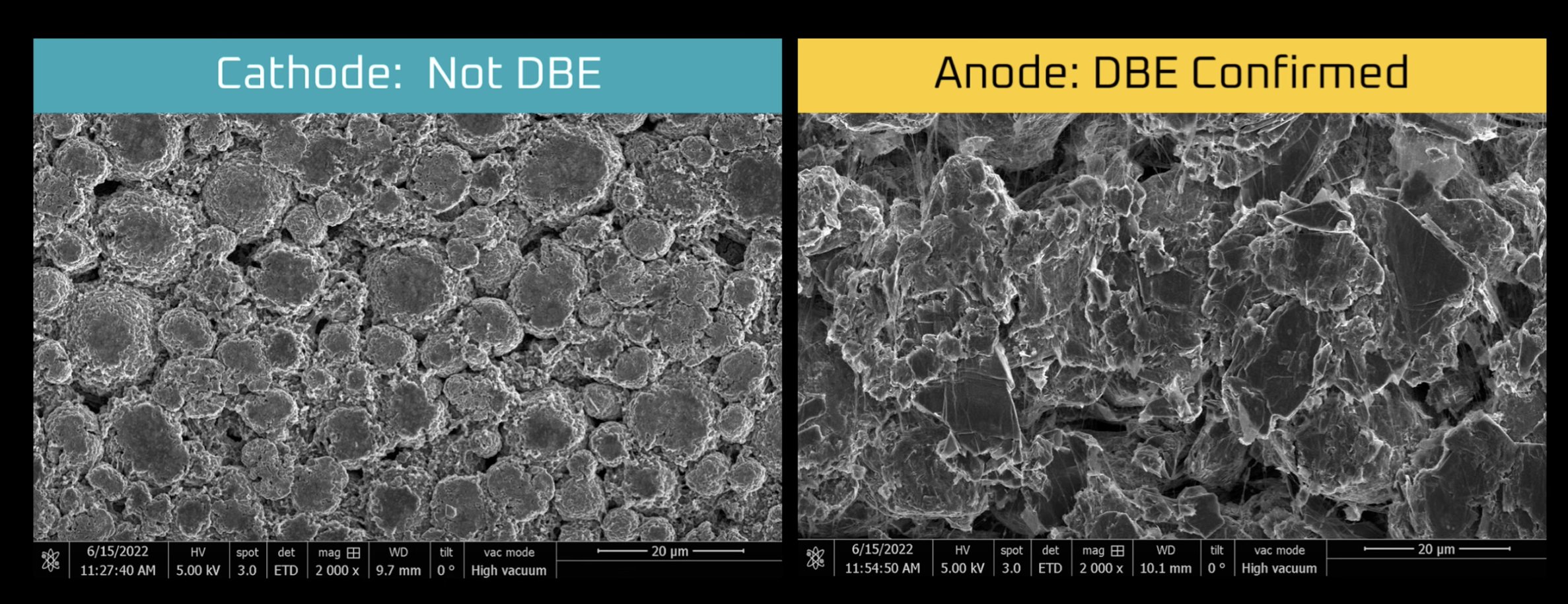
<p><code class="language-plaintext highlighter-rouge">2:30</code> - I admit I was quite surprised to see the evidence for the dry coating process here, and only on the anode too It’s the first time I’ve heard of it in a production cell. Couldn’t tell you why it’s used on one but not the other, but they are quite different materials…</p>

<div class="card mb-3">
    <img class="card-img-top" src="/img/posts/4680teardown-13.jpeg" />
    <div class="card-body bg-light">
        <div class="card-text">
            Evidence for dry coating
        </div>
    </div>
</div>

<p><code class="language-plaintext highlighter-rouge">3:12</code> - I was also surprised to see NMC 811 rather than NCA as in their 2170 cells. Rather than being less Co, it’s actually almost certainly a bit more than they used to use…!</p>

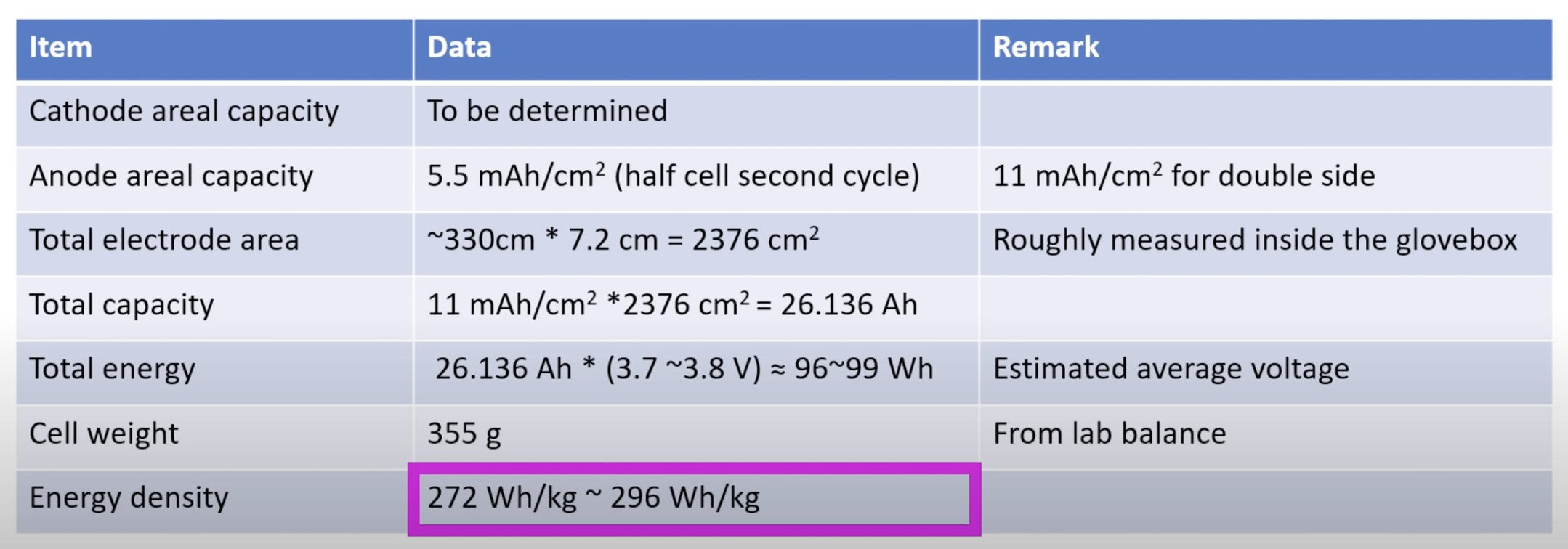
<p><code class="language-plaintext highlighter-rouge">3:30</code> OK, onto energy density. I suspect there might be some overestimation here… and perhaps bias from an expectation that the cell should have an exceptionally high energy density? Will dig into this shortly…</p>

<p><code class="language-plaintext highlighter-rouge">6:08</code> - Surprise #3, no Si in the anode, which @limitingthe says is a “deliberate choice” - and it certainly is, since this is against what I expected the trend in passenger EVs to be, so it should tell us something.</p>

<p><code class="language-plaintext highlighter-rouge">8:11</code> - The conclusion is that the two handicaps of a very thick can and no silicon are offset by thicker electrodes to beat the energy density of the 2170. I’m not sure this is fully correct, but the later points of pack integration and manufacturability are important.</p>

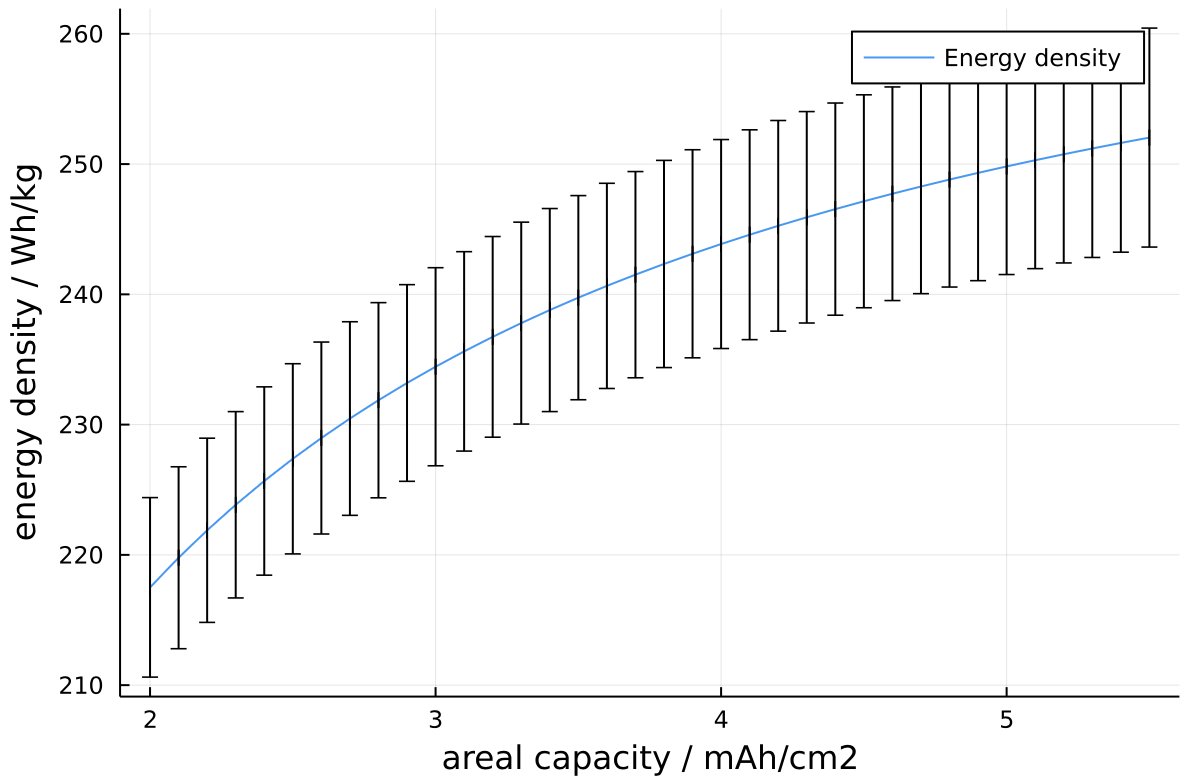
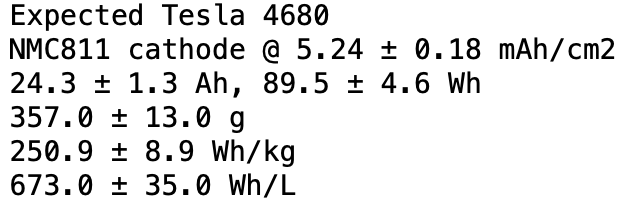
<p>So to dig into details here, I dusted off my cell model and tried to find something representative based on the data available so far. This is what I get: 24-25 Ah and ~250 Wh/kg, less than I expected and less than UCSD calculated so far.</p>

<div class="card mb-3">
    <img class="card-img-top" src="/img/posts/4680teardown-14.png" />
    <div class="card-body bg-light">
        <div class="card-text">
            Energy density estimate
        </div>
    </div>
</div>

<p>A few numbers are best guesses, but otherwise thicknesses, jelly roll length etc roughly agree with measurements. There’s a few reasons why I think my numbers might be a bit closer to reality.</p>

<ol>
  <li>I don’t expect thicker electrodes offset much the thick can and the lack of Si. The 2170 cell +ve electrodes are ~4.5 mAh/cm2. Going up to ~5.2-5.3 (my estimate) is about a 2-3% energy bump. The can thickness is a &gt;10% penalty and lack of Si not far behind.</li>
</ol>

<div class="card mb-3">
    <img class="card-img-top" src="/img/posts/4680teardown-15.jpeg" />
    <div class="card-body bg-light">
        <div class="card-text">
            Energy density vs areal capacity
        </div>
    </div>
</div>

<ol>
  <li>Estimating cell-level capacity from anode areal capacity will overestimate slightly because of balancing and first-cycle losses. (Also the voltage is a tiny bit overestimated, nominal for NMC811/Gr should be ~3.68 V).</li>
</ol>

<div class="card mb-3">
    <img class="card-img-top" src="/img/posts/4680teardown-16.jpeg" />
    <div class="card-body bg-light">
        <div class="card-text">
            Table of material level properties
        </div>
    </div>
</div>

<p>A difficulty is, if this cell hasn’t gone through formation, we can’t account for first cycle losses accurately, because there haven’t been any. As an example, I know from my own data that in Tesla’s 2170 cell, the actual cyclable mAh/cm<sup>2</sup> is a bit &lt;15% of the anode mAh/cm<sup>2</sup> (I have been conservative with my model and assumed relatively close balancing and low initial losses, so my effective n/p ratio comes out to be ~1.08).</p>

<p>So why does it make sense for the energy density to be lower, you might ask? Well, I think the answer is a) it is what it needs to be, b) cycle life (maybe) and c) (probably mostly) cost optimisation.</p>

<p>First
@limiting_the is right to point out that it’s part of a ‘structural’ pack with better integration efficiency so that makes up for any sacrifices on the cell level (which by my numbers is still on par with the 2170 cell, which is also ~250 Wh/kg). Second, I first assumed the exclusion of Si might be for cycle life reasons - Si does come with a cycle life penalty, and maybe the larger form factor does also? Though I am mainly wondering out loud on this point.</p>

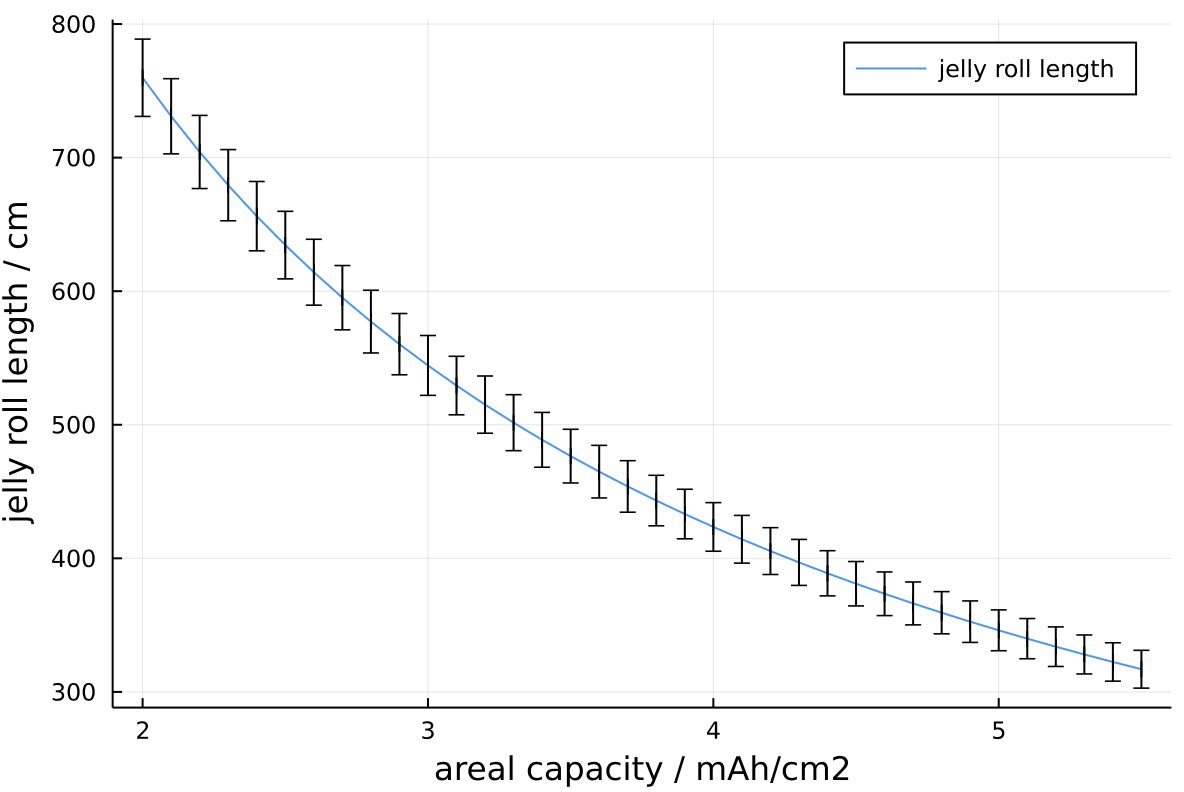
<p>I think the bigger aspect (incl. the thicker electrodes) is probably cost optimisation. Going up in mAh/cm2 bumps energy by 2-3% but decreases the length of the electrode that needs to be coated by almost 15%, and this saves some cost.</p>

<div class="card mb-3">
    <img class="card-img-top" src="/img/posts/4680teardown-17.jpeg" />
    <div class="card-body bg-light">
        <div class="card-text">
            Jelly roll length vs areal capacity
        </div>
    </div>
</div>

<p>Adding Si would make the negative electrode thinner, but also make the length of jelly roll per cell longer again (also by ~15% by my estimation). Don’t have much feel for how much this affects cost but I’m assuming it is not negligible…</p>

<p>So to wrap up, because this thread is already much too long, certainly at first glance Tesla’s 4680 looks like a very high quality cell, with some cutting edge production methods. We’ll have to wait and see about performance later, but my guess is the energy density will come in a bit lower than many expect. My numbers might be a bit off, but 250 Wh/kg is also about right for large format prismatics with the same chemistry so to me it fits.</p>

<p>I would be quite surprised if the production version comes in at &gt;270 Wh/kg unless something has changed significantly from this version. But it doesn’t matter - even at 250 Wh/kg cell level I’m sure the pack integration means the Wh/kg on system level beats the 2170 pack. And I’m guessing it doesn’t compromise from the 2170 on any other metric, e.g. charging time. Boosting performance further can come later, but my guess is the main focus now has been cost optimisation, which is what Tesla made a big fuss about on battery day anyway.</p>]]></content><author><name></name></author><category term="batteries" /><category term="twitter" /><category term="tesla" /><summary type="html"><![CDATA[Original post at Twitter here So I had been meaning for a while to do a little commentary on the Tesla 4680 teardown organised by The Limiting Factor, partly because teardown is part of my day job… so here come some observations, starting with the “part 1” video: 4:27 - Cell voltage is pretty low, 0.14 V - which is way below the usual 0% SoC. The cell is dented, but the voltage is not zero, so tells me it’s not short circuited (at least at the time of teardown) - guessing it was discarded from the line and hasn’t gone through formation]]></summary></entry><entry><title type="html">Are Prussian Blue analogue (PBA)-based Na-ion batteries safe?</title><link href="/2022/06/26/prussian-blue-analogue-safety.html" rel="alternate" type="text/html" title="Are Prussian Blue analogue (PBA)-based Na-ion batteries safe?" /><published>2022-06-26T00:00:00+00:00</published><updated>2022-06-26T00:00:00+00:00</updated><id>/2022/06/26/prussian-blue-analogue-safety</id><content type="html" xml:base="/2022/06/26/prussian-blue-analogue-safety.html"><![CDATA[<div class="alert alert-info">
Original post at Twitter <a href="https://twitter.com/mjlacey/status/1541042836031823872?s=20&amp;t=CKdI3MiCE54M6PwVqBB3sw">here</a>
</div>

<p>Are Prussian Blue analogue (PBA)-based Na-ion batteries safe? Safer than LFP? It’s been argued to me a number of times that no oxygen in the cathode means no thermal runaway, but is that true? I think the evidence suggests no, and the hazards may actually be quite significant:</p>

<!--more-->

<p>For those not familiar with Na PBAs, they are compounds with general formula Na<sub>x</sub>M[M’(CN)<sub>6</sub>] where M and M’ are transition metals (e.g. Fe, Ni, Mn). The structures are quite stable but in principle can decompose at high temperatures, releasing the cyanide (CN) ligand.</p>

<p>Also - worth noting that CN accounts for ~50 wt% of the cathode, so it is present in pretty large amounts.</p>

<p>This presents a few possibilities: generation of hydrogen cyanide gas (HCN, very toxic), cyanogen ((CN)<sub>2</sub>, rocket propellant, also very toxic), and the cyanide anion (CN<sup>-</sup>) itself, which is a good nucleophile (i.e., reactive). Is there any evidence for this?</p>

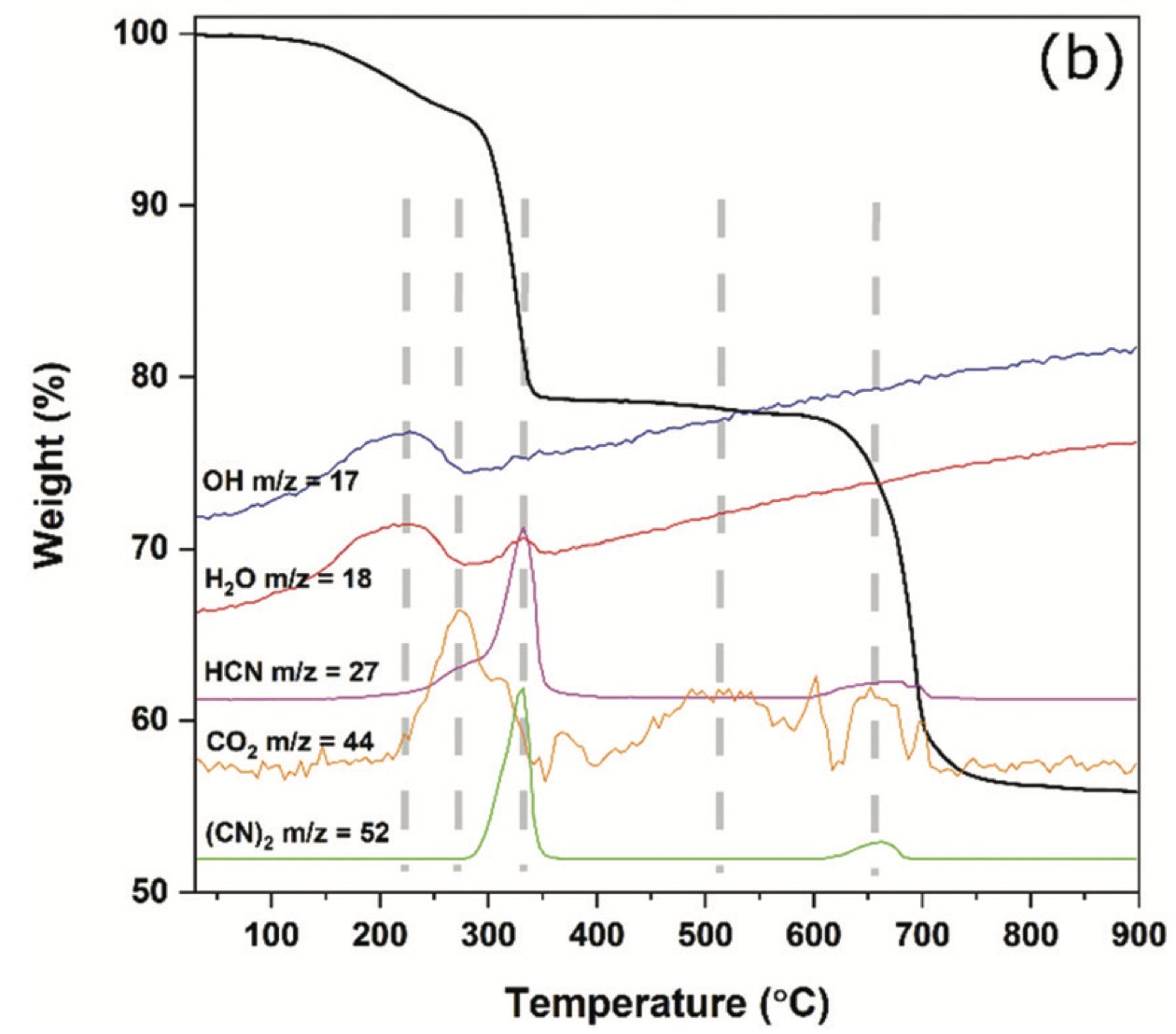
<p>Actually, some: a <a href="https://t.co/3spqyPMizA">paper from my old group</a> looked at the thermal stability of ‘Prussian White’ (M &amp; M’ = Fe) and found that when fully charged, at ~300 °C there was a ~15% mass loss dominated by evolution of HCN and (CN)<sub>2</sub>.</p>

<div class="card mb-3">
    <img class="card-img-top" src="/img/posts/pbasafety-1.jpeg" />
    <div class="card-body bg-light">
        <div class="card-text">
            TGA-MS of Prussian White
        </div>
    </div>
</div>

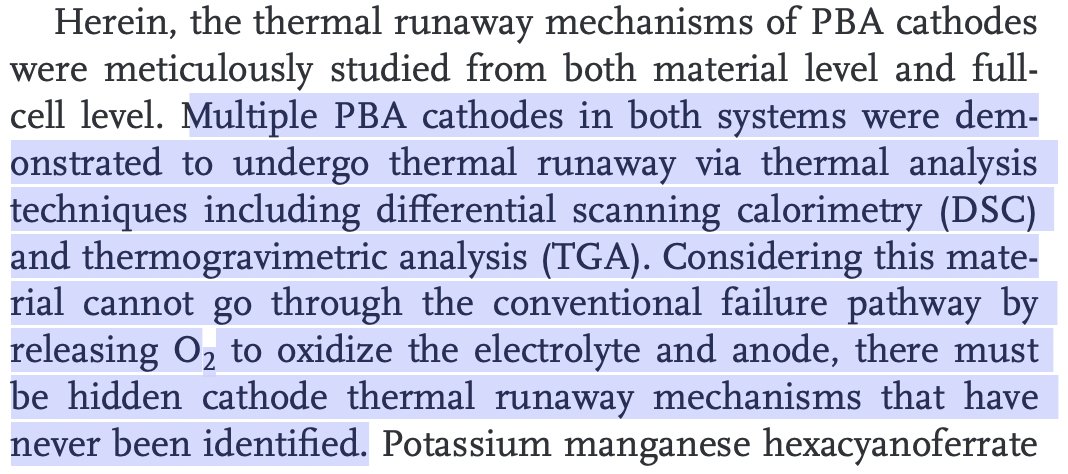
<p>A <a href="https://doi.org/10.1002/aenm.202101764">more recent study</a> has also looked at the stability of PBAs in contact with electrolyte and found similar gas evolution, but also an exothermic reaction with the electrolyte.</p>

<div class="card mb-3">
    <img class="card-img-top" src="/img/posts/pbasafety-2.jpeg" />
    <div class="card-body bg-light">
        <div class="card-text">
            Excerpt from the article
        </div>
    </div>
</div>

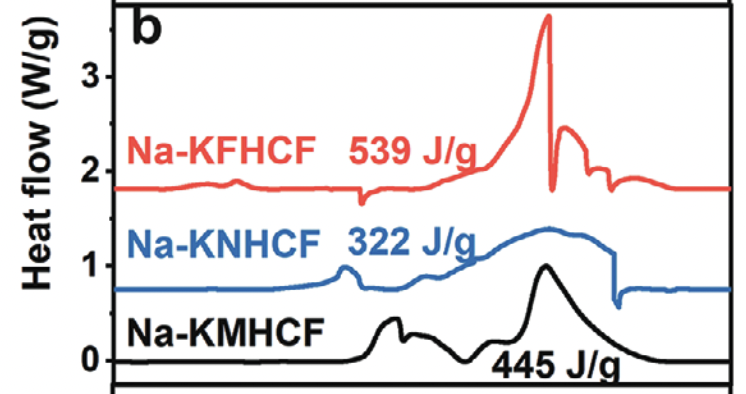
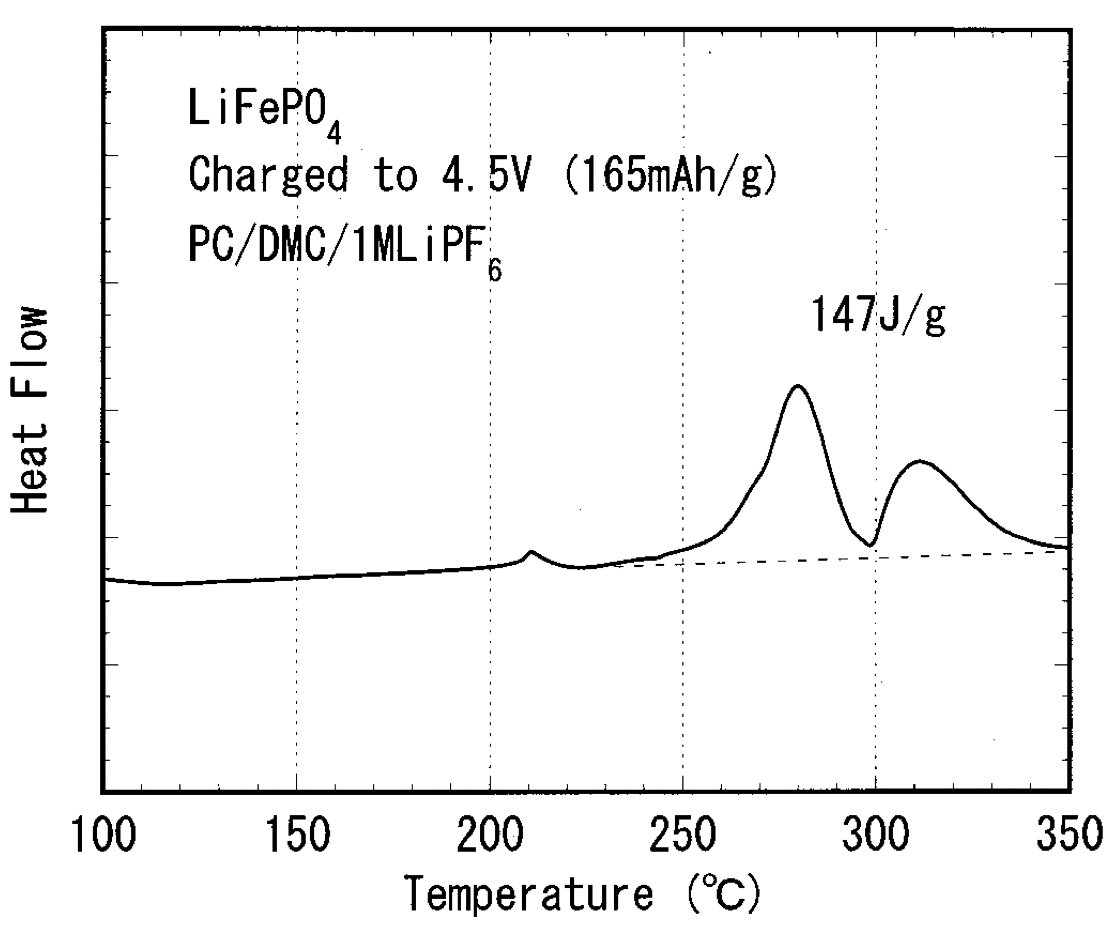
<p>One thing that caught my eye was the magnitude of the heat release from DSC experiments. For a similar Fe-based PBA, the heat release was measured at 539 J/g. Looking elsewhere in the literature you find similar numbers for NMC111 and ~3x what has been measured for LFP…</p>

<div class="card mb-3">
    <img class="card-img-top" src="/img/posts/pbasafety-3.png" />
    <div class="card-body bg-light">
        <div class="card-text">
            DSC of Prussian Blue Analogues with electrolyte
        </div>
    </div>
</div>

<div class="card mb-3">
    <img class="card-img-top" src="/img/posts/pbasafety-4.jpeg" />
    <div class="card-body bg-light">
        <div class="card-text">
            DSC of LFP with electrolyte
        </div>
    </div>
</div>

<p>It’s also more than what the same group measured for NaCoO<sub>2</sub> in <a href="https://pubs.acs.org/doi/full/10.1021/acsami.1c04482?casa_token=rHkT25Q1LWMAAAAA%3Ar9wKM8XjSQfMgemQxlfnWnS8fm5HnPQWbykrpTf9oEe2JdAwDA21GidTQQ_cPgU8luDa6lSg32bI-s0t5g…">another paper</a> from last year (which interestingly was found to be more frisky when discharged).</p>

<p>Anyway, I think the comparison with LFP is most interesting because this is where the Na-ion cells are best positioned to compete, on cost, sustainability, energy density, etc. Does this mean the PBA Na-ion cells will be more unsafe than LFP?</p>

<p>I’d say not necessarily, there are too many unknowns at the moment. But maybe we can hypothesise a bit. LFP and PBA have similar specific capacities (mAh/g), so two cells of the same capacity will have similar amounts of cathode.</p>

<p>If the heat release is as indicated earlier, the Na-ion cell could be expected to have a more energetic thermal runaway, with a similar-ish onset temperature.</p>

<p>But, the Na-ion cell will have lower Wh/L, so more ‘thermal ballast’, and other differences (anode, SEI, electrolyte stability, etc) will affect the process as well.</p>

<p>This is also not to suggest either that the propagation can’t be controlled on system level, especially not now that CATL are presenting high-Ni CTP batteries with very high system efficiencies.</p>

<p>However, experience tells us that even packs where cell-to-cell propagation is supposedly eliminated can still become large fires in the worst cases, so I don’t believe the possibility can ever be ruled out while you have a combustible electrolyte and potential exotherms. So it is hard to make too many predictions, especially since I am not aware that there are any (public) results of safety testing on any large PBA cell yet.</p>

<p>One thing I would definitely conclude however is that there’s currently no basis on which to declare PBA Na-ion as safe, or at no risk of thermal runaway. In fact the reports of very large HCN and (CN)<sub>2</sub> release I think need much more careful consideration.</p>

<p>The immediate danger to life and health (IDLH) level for HCN is set by NIOSH as 50 ppm. This is <em>twenty-four</em> times lower than the value for carbon monoxide (CO), the main toxic gas concern for conventional LIBs.</p>

<p>What this means is that even if you have 5% of the CN content of only one relatively large (say, 200 Ah) cell released as HCN, it needs to be diluted into &gt;600 m<sup>3</sup> to be below 50 ppm.</p>

<p>This would be pretty bad in an enclosed space, e.g. a parking garage or tunnel - and most people cannot smell HCN for genetic reasons.</p>

<p>Anyway, tl,dr: Recent research suggests PBA Na-ion cells not only undergo thermal runaway, but potentially quite energetically - &amp; come with a unique toxic hazard which doesn’t seem to have gotten very much attention yet despite upcoming market introduction. Needs more study!</p>

<p>addendum: I was looking for info from CATL on the safety of their cells but couldn’t find more than a statement that they pass the relevant safety tests, which is not particularly informative. Would be very interested to see more detailed data if ever available.</p>]]></content><author><name></name></author><category term="batteries" /><category term="twitter" /><category term="Na-ion" /><category term="reality check" /><summary type="html"><![CDATA[Original post at Twitter here Are Prussian Blue analogue (PBA)-based Na-ion batteries safe? Safer than LFP? It’s been argued to me a number of times that no oxygen in the cathode means no thermal runaway, but is that true? I think the evidence suggests no, and the hazards may actually be quite significant:]]></summary></entry><entry><title type="html">Looking for feedback from my followers on the future of this website</title><link href="/2022/06/06/looking-for-feedback-from-followers.html" rel="alternate" type="text/html" title="Looking for feedback from my followers on the future of this website" /><published>2022-06-06T00:00:00+00:00</published><updated>2022-06-06T00:00:00+00:00</updated><id>/2022/06/06/looking-for-feedback-from-followers</id><content type="html" xml:base="/2022/06/06/looking-for-feedback-from-followers.html"><![CDATA[<div class="alert alert-info">
Original post at Twitter <a href="https://twitter.com/mjlacey/status/1533836223621611520?s=20">here</a>
</div>

<p>Looking for some feedback from my followers regarding the future of my website, in particular the electrochemistry &amp; battery chem tutorials..</p>

<p>What started out as a barely-visited personal website while a postdoc has become seemingly a quite popular resource for knowledge on niche academic topics (particularly impedance spectroscopy), with consistently ~3000 visitors/month for several years now. I’m very happy, and flattered, that so many have found it useful in spite of the fact that I never really attempted to market it, or even develop it much in the last 6 years or so.</p>

<!--more-->

<p>However for a variety of reasons I think a crossroads will soon be reached where I need to consider what to do with the website and its content. Part of it is technical, e.g. it is hosted on a VPS using a version of Linux that is no longer supported and that I would have trouble updating. Part of it is professional circumstance, since for 3 years I have been in industry and don’t feel the same need to advertise myself with a personal website.</p>

<p>Part of it is, to be completely honest, financial, since it costs a not-negligible amount of money to essentially only maintain the existing content. And part of it is time and motivation in developing it, which has become harder to find since leaving the academic world. However I am aware many appreciate what little I have created and would like to maintain it. I’m also aware that there is relatively little good, accessible educational material for fundamental &amp; applied battery electrochemistry, experimental methods etc in general.</p>

<p>So I have been considering, at some point in the future, re-launching my website as a business, on a different platform, where all the stuff that currently exists on my website today (and probably more besides) would be freely available as before, but with the possibility of extra material, whatever that might be (e.g. case studies, tutorial exercises w/ full explanations, maybe video lessons, maybe specific custom requests) as available to purchase for a reasonable price. Topics could be niche areas/methods like EIS, transference etc like I have on my site now, but also more general battery chemistry, technical analysis of specific technologies/future chemistries/companies could also be possibilities.</p>

<p>My hope would be that this would give better prospects for developing a good, more comprehensive and more accessible resource for the battery community and in a way that potentially opens up for contributors besides only me. What I am curious about is, is this something you (personally, your organisation, etc) would be interested in? What would you want to see?</p>]]></content><author><name></name></author><category term="batteries" /><category term="twitter" /><summary type="html"><![CDATA[Original post at Twitter here Looking for some feedback from my followers regarding the future of my website, in particular the electrochemistry &amp; battery chem tutorials.. What started out as a barely-visited personal website while a postdoc has become seemingly a quite popular resource for knowledge on niche academic topics (particularly impedance spectroscopy), with consistently ~3000 visitors/month for several years now. I’m very happy, and flattered, that so many have found it useful in spite of the fact that I never really attempted to market it, or even develop it much in the last 6 years or so.]]></summary></entry><entry><title type="html">Two more excellent papers</title><link href="/2022/03/22/two-more-excellent-papers.html" rel="alternate" type="text/html" title="Two more excellent papers" /><published>2022-03-22T00:00:00+00:00</published><updated>2022-03-22T00:00:00+00:00</updated><id>/2022/03/22/two-more-excellent-papers</id><content type="html" xml:base="/2022/03/22/two-more-excellent-papers.html"><![CDATA[<div class="alert alert-info">
Original post at Twitter <a href="https://twitter.com/mjlacey/status/1506565478227054592?s=20">here</a>
</div>

<p>Two more excellent Li-S battery papers from <a href="https://twitter.com/yuchuan_chien">@yuchuan_chien</a> published in as many days!</p>

<!--more-->

<p>First: a <a href="https://doi.org/10.1002/batt.202200058">study of the effect of electrode compression/calendering on electrochemical performance</a>, w/ operando XRD and x-ray CT, published in <a href="https://twitter.com/Batt_Supercaps">@Batt_Supercaps</a>.</p>

<p>This study really started as far back as 2015, following already published work showing calendering improved cycle life… which we initially found too but got poor reproducibility over the first couple of years. Eventually, Yu-Chuan found a way to get consistent results. And this looked promising, because we could compress an electrode to ~1/3 of its original thickness without sacrificing much performance, which seemed to have good implications for volumetric energy density, one of Li-S’s (many) weak points. Problem is that a lot of other factors come into play as well, affecting capacity and resistance and we struggled to understand what was actually going on. So even though Yu-Chuan’s PhD started out on this research question, it needed 4 years of method development to answer…</p>

<p>Now with CT, we could quantify porosity and tortuosity in the electrodes, and with the operando XRD + resistance analysis methods developed in recent years, follow how lithium sulfide (Li2S) is formed in the electrodes depending on the degree of compression. (The bad news is that the electrode expands back to close its original thickness after a few cycles, blunting hopes for improved energy density somewhat… perhaps a better binder would help.)</p>

<p>Next, Yu-Chuan’s study on correlating precipitation processes to electrochemical performance through operando small-angle scattering is now <a href="https://doi.org/10.1016/j.chempr.2022.03.001">published in Chem</a>. Something of a development of the operando XRD methods already developed, the small-angle neutron &amp; x-ray methods let us look at physical particles, and not just the crystalline stuff. This mattered because we found that at quite low currents we started getting an amorphous product forming close to end of discharge.</p>

<p>Correlating this to electrochemical measurements (and taking into account the other studies done over the period of Yu-Chuan’s PhD) we could conclude that depletion of Li ions in the pores of the carbon host is probably limiting the discharge capacity at low rate. And I think these papers, my 17th and 18th on lithium-sulfur I have co-authored, will be the last Li-S papers I am involved in for the forseeable future…</p>]]></content><author><name></name></author><category term="batteries" /><category term="twitter" /><category term="Li-S" /><summary type="html"><![CDATA[Original post at Twitter here Two more excellent Li-S battery papers from @yuchuan_chien published in as many days!]]></summary></entry><entry><title type="html">Response to Tim Holme</title><link href="/2022/02/09/response-to-tim-holme.html" rel="alternate" type="text/html" title="Response to Tim Holme" /><published>2022-02-09T00:00:00+00:00</published><updated>2022-02-09T00:00:00+00:00</updated><id>/2022/02/09/response-to-tim-holme</id><content type="html" xml:base="/2022/02/09/response-to-tim-holme.html"><![CDATA[<div class="alert alert-info">
Original post at Twitter <a href="https://twitter.com/mjlacey/status/1491328073165598722?s=20">here</a>,
in response to <a href="https://twitter.com/ironmantimholme/status/1491225833650135044?s=20">this exchange</a> with QuantumScape CTO Tim Holme.
</div>

<p>Many thanks and credit to <a href="https://twitter.com/ironmantimholme">@ironmantimholme</a> for taking the time to reply and give us all a bit more insight into QuantumScape’s thinking! I do also agree with a lot of it and appreciate the value of proving capability at single layer - if it doesn’t work there it’ll never work.</p>

<p>I would also agree that Li plating is likely a major failure mode for the 2170 cell. In Sweden we have had a close academic-industrial collaboration on degradation in commercial cells - the last phase being the so-called “fast-charging project” where my colleagues looked at the degradation of cells charged at rates up to 4C, finding Li plating was significant from 3C and associated gas evolution at 4C giving a large impedance rise that led to similarly rapid cap. loss. This was <a href="https://doi.org/10.1016/j.jpowsour.2019.02.095">published a few years ago (open access)</a>.</p>

<!--more-->

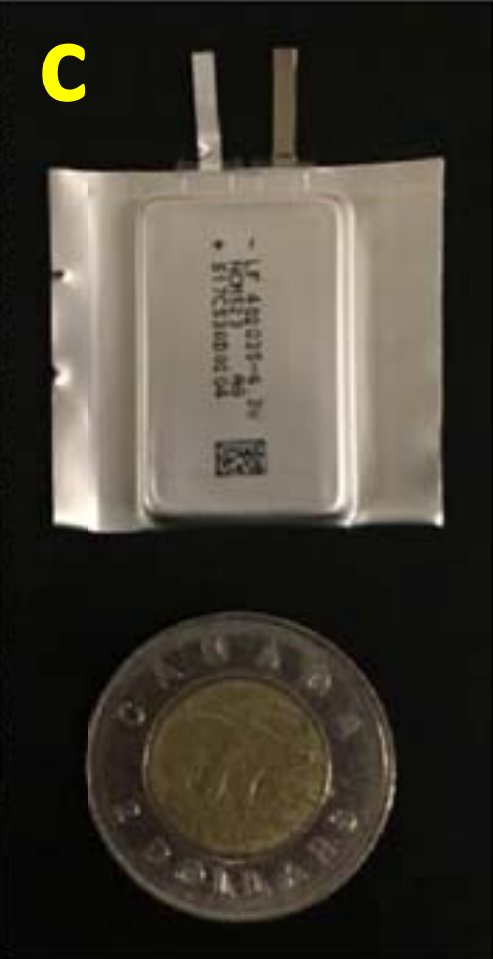
<p>I think the point of single layer performance being something that can be approached asymptotically at multilayer with good engineering is a nice way to think about it. I had similar thoughts about Jeff Dahn’s <a href="https://iopscience.iop.org/article/10.1149/2.0981913jes">widely shared ‘million mile battery’ paper</a>… which, while multilayer, are pretty small and similar capacity in the end (0.24 Ah) - more I thought as a demonstration of potential performance and not necessarily what we would see imminently in large scale cells.</p>

<div class="card mb-3">
    <img class="card-img-top" src="/img/posts/small-pouch.jpeg" />
    <div class="card-body bg-light">
        <div class="card-text">
            Photograph of small multi-layer pouch cell, from Harlow <i>et al.</i>, 2019
        </div>
    </div>
</div>

<p>Anyway, hopefully we all agree that it’s healthy to keep a critical (and self-critical) perspective on performance when we’re still at small scale - and we’re all keen to see this level of performance reproduced in the “real thing”!</p>

<p>P.S.: one thing I also wanted to mention from the Mussa et al paper linked before is the observation of different extents of degradation in different sample locations in the cell - what I refer to as ‘within-cell heterogeneity’. This I believe is a big aspect of degradation in large scale cells simply because the bigger you go, the more scope you have for uneven distributions of pressure, temperature, stress - leading to distributions in the reactions, and degradation mechanisms, themselves.</p>

<p>And once you have a severe ageing mechanism such as lithium plating, or gas evolution, or cathode breakdown arising because the distribution of the current and electrode potential in the cell is inefficient, it will just help accelerate the process. It is also something that (I believe) can be mitigated through good engineering and understanding at the materials level, and is increasingly a major research interest of mine. I’m also coordinating the successor of the “fast charging project”, so watch this space for updates…</p>]]></content><author><name></name></author><category term="batteries" /><category term="twitter" /><category term="startups" /><category term="quantumscape" /><category term="ageing" /><category term="heterogeneity" /><summary type="html"><![CDATA[Original post at Twitter here, in response to this exchange with QuantumScape CTO Tim Holme. Many thanks and credit to @ironmantimholme for taking the time to reply and give us all a bit more insight into QuantumScape’s thinking! I do also agree with a lot of it and appreciate the value of proving capability at single layer - if it doesn’t work there it’ll never work. I would also agree that Li plating is likely a major failure mode for the 2170 cell. In Sweden we have had a close academic-industrial collaboration on degradation in commercial cells - the last phase being the so-called “fast-charging project” where my colleagues looked at the degradation of cells charged at rates up to 4C, finding Li plating was significant from 3C and associated gas evolution at 4C giving a large impedance rise that led to similarly rapid cap. loss. This was published a few years ago (open access).]]></summary></entry><entry><title type="html">On QuantumScape’s cell performance</title><link href="/2022/02/07/on-quantumscapes-cell-performance.html" rel="alternate" type="text/html" title="On QuantumScape’s cell performance" /><published>2022-02-07T00:00:00+00:00</published><updated>2022-02-07T00:00:00+00:00</updated><id>/2022/02/07/on-quantumscapes-cell-performance</id><content type="html" xml:base="/2022/02/07/on-quantumscapes-cell-performance.html"><![CDATA[<div class="alert alert-info">
Original post at Twitter <a href="https://twitter.com/mjlacey/status/1490726404207652870?s=20">here</a> in response to <a href="https://www.theinformation.com/articles/quantumscape-s-fast-charging-claims-have-sparked-a-backlash">public criticism</a> of QuantumScape's performance claims by one of their competitors, Cuberg.
</div>

<p>Probably should go without saying that criticism from a competitor should be taken with a pinch of salt. But still, not for the first (or last) time <a href="https://twitter.com/QuantumScapeCo">@QuantumScapeCo</a> spark debate with a showcase of their technology with only small-scale cells…</p>

<p>Now I’ve found these showcases very interesting so far, but I think the big problem is that they are presentations which would feel more at home at a battery conference, rather than the main vehicle for a public company communicating their progress to the public. And at the core of this debate are questions about what properties or performance attainable at single-layer credit card-size cell size (~0.1-0.2 Ah) can be scaled to automotive (»10 Ah). And this is an important Q for applied research where the answer isn’t always obvious.</p>

<!--more-->

<p>There is also the shadow of any number of defunct startups that failed on this point. To their credit, QS show that they do get this, and have shared details (such as mAh/cm²) to alleviate worries about relevance in the absence of bigger cells, which other startups are showing. I think a single-layer, zero excess anode with a solid-solid Li/separator interface with &gt;3 mAh/cm² certainly demonstrated in 2020 that QS have a system that shows great <strong>potential</strong> for  a new cell chemistry that combines high energy, high cycle life, and fast charge.</p>

<p>In comparison with many past Li metal research papers (and companies) there isn’t too much scope here for fudging on cycle life and current density (e.g. with thin electrodes, lots of excess Li and electrolyte). Hence why many of us get very interested.</p>

<p>But one of the most common questions I see levelled at QS is on energy density, which they resist disclosing. And I see why, because on single-layer level, energy density does not matter - it’s not going to be great. What matters is the energy density of the final product.</p>

<p>And given the details we can hazard a pretty decent guess - I have done this a number of times before. The only important missing info is the separator thickness - I don’t really know why QS don’t disclose it, but Tim Holme at least hinted to #BMWS it’s “low tens of microns”. By my guesses that’s enough info for me to feel happy that QS are on track to hit &gt;900 Wh/L, <em>if</em> they can scale to an acceptably large cell. We have seen hints of this at least, but not close to the final product, so manufacturing is still the big Q it was 18 months ago.</p>

<p>But, I digress - we were talking about fast charge. And in this respect there factors that scale non-linearly with cell size that we have to think about, e.g. thermal management. Any battery charged at 4C will start to get pretty warm depending on its internal resistance. A single layer cell might manage this ok, if it’s clamped between two big heat sinks. A cell with dozens of layers might not lose heat as efficiently and this could have significant consequences for how it degrades - not just Li but the cathode as well.</p>

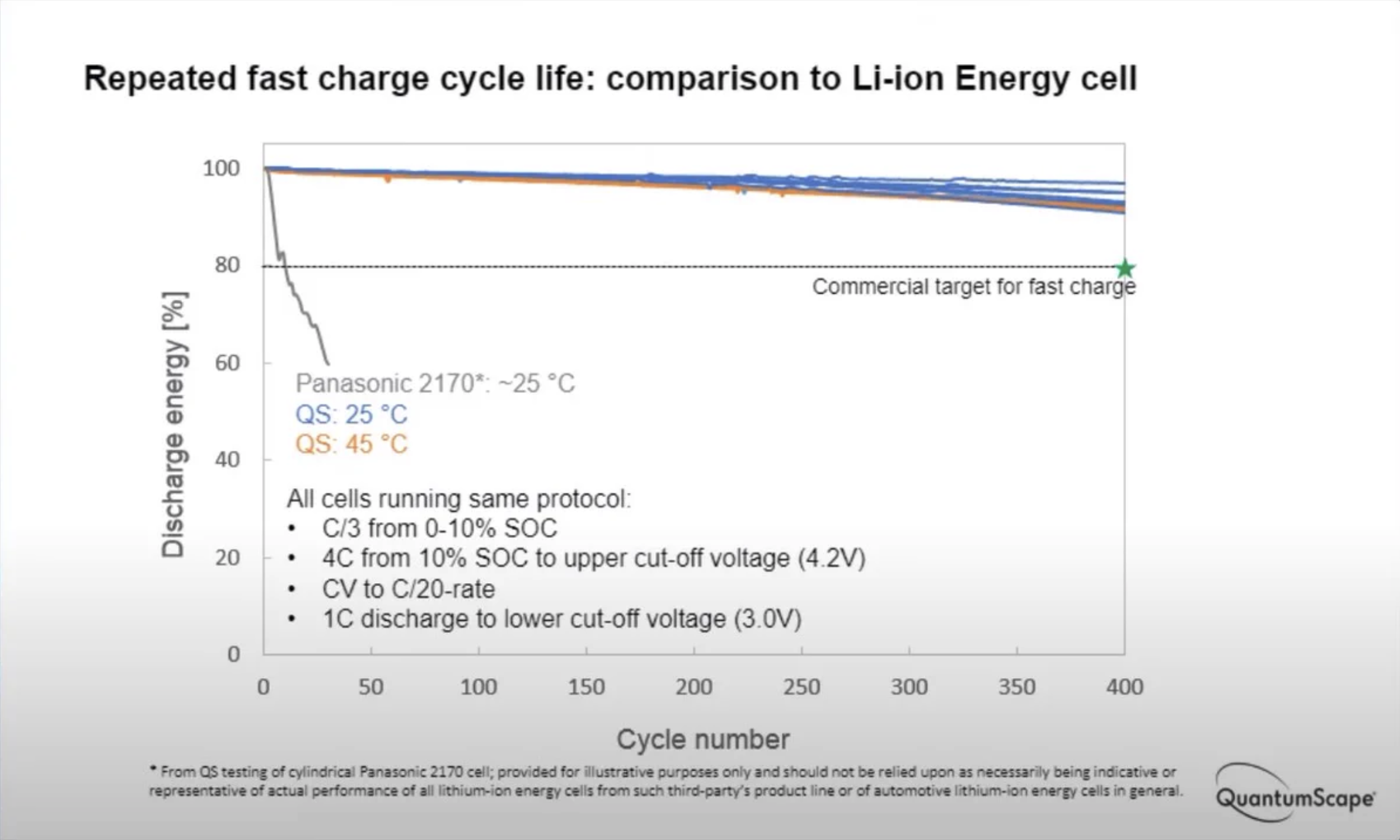
<p>And in this respect I think QS have been making some slightly unfair comparisons, comparing with a 2170 cell more than an order of magnitude larger in capacity. If we want to talk fundamental mechanisms, a like-for-like single layer comparison would be a lot better.</p>

<div class="card mb-3">
    <img class="card-img-top" src="/img/posts/qs-fastcharge.png" />
    <div class="card-body bg-light">
        <div class="card-text">
            Slide showing the fast charge cycle life of QuantumScape's battery cells, from QuantumScape
        </div>
    </div>
</div>

<p>And we can’t speculate that much on how the QS cell would fare with dozens of layers - we don’t know its resistance characteristics, thermal properties. And managing the heating can often be the bigger problem than the chemistry limitations themselves.</p>

<p>So while it’s interesting &amp; encouraging to think about overcoming these chemistry related limitations, this risks feeling like a distraction from the main questions, and would be more effective to demonstrate in e.g. 10 layer cells they have shown already. And I think that not-quite-cricket comparisons like the above, and what I call “selective transparency” unnecessarily risks credibility. I would happily see more like-for-like comparisons with typical Li-ion, and if we’re going to get into the details and numbers, then share relevant ones - e.g. DCIR (in Ω cm²), and hopefully separator thickness??</p>]]></content><author><name></name></author><category term="batteries" /><category term="twitter" /><category term="startups" /><category term="quantumscape" /><summary type="html"><![CDATA[Original post at Twitter here in response to public criticism of QuantumScape's performance claims by one of their competitors, Cuberg. Probably should go without saying that criticism from a competitor should be taken with a pinch of salt. But still, not for the first (or last) time @QuantumScapeCo spark debate with a showcase of their technology with only small-scale cells… Now I’ve found these showcases very interesting so far, but I think the big problem is that they are presentations which would feel more at home at a battery conference, rather than the main vehicle for a public company communicating their progress to the public. And at the core of this debate are questions about what properties or performance attainable at single-layer credit card-size cell size (~0.1-0.2 Ah) can be scaled to automotive (»10 Ah). And this is an important Q for applied research where the answer isn’t always obvious.]]></summary></entry></feed>